

I wrote this recollection of my childhood as a gift to my sons Link and Lance, and to my grandchildren, and grands, whom I love dearly. This is something I have planned to do for years but had never taken the time.
Time passes so quickly, and one never realizes how precious life’s Moments are until so many have passed by it’s hard to remember them all. I have never considered myself a writer, and really have no idea of how to begin this endeavor, but have dedicated this, my 59th year of life, to achieve it.
Editors note: Lea wrote this in late 2004-2005. Her work on this ended in July 2005 when she was stricken ill with acute necrotizing pancreatitis and given a 15% chance of survival. Although she survived, she never returned to documenting her memories. You can read about her miraculous survival here on the blog “Surviving Gods Woodshed”. This life story has been expanded and illustrated by her husband.
Childhood Memories

I was born on January 29, 1946. My parents were May Pauline Leffert Tate and Roy Davis Tate. I was born at home, which was a houseboat brought to rest inland on the bank of Bear Creek, near the bridge in the 600 block of Ely Street in Hannibal, Missouri. Mother remembered it as a Monday afternoon at about 4:15 p.m.
My father worked as a track laborer on the CB&Q (Chicago, Burlington & Quincy) Railroad, and someone, probably one of my grandfathers, walked down to the railroad yards to find him and bring him home.

My birth certificate was registered on March 13, 1946, listing my time of birth as 4:05 P.M. January 29, 1946. I was delivered by Dr. E. R. Mottley, M.D. at my residence, a houseboat docked at 619 Ely Street, Hannibal, Missouri.
My parents were Roy Davis Tate and May Pauline Leffert Tate. The certificate also lists that Mother had three other children living and that she had not given birth to any that were then dead. We know this to be an error, and believe that Dr. Mottley probably failed to ask that question directly, and made an incorrect assumption.

I was the fourth child born to Roy and Pauline. Mother said Daddy was very happy I was a girl. My oldest brother, Robert LeRoy was a twin, born on February 20, 1941. There was a twin sister, Roberta Lucille, however, she died when she was only three days old. Another older brother, James Wesley, was born on August 7, 1944.

My father chose my name, Leona Marie. Mother told me it wasn’t until years later that she learned it was the name of one of Daddy’s old girlfriends. I’m not sure that she was that special to him, but he did like her name.
Dad had only been working for the railroad only a short time and was excited to be working for a large company. His starting salary was 75 cents a day, which today does not seem like a lot, however, it was quite a lot more than he had been making working as a farm hand. It was the full-time job with the CB&Q Railroad that brought him and his young family to Hannibal.
They had previously lived in various rental units on farms where daddy worked, and at the “Homeplace,” a two-room cabin on a small plot of land in the middle of the woods near Hester, Missouri. Daddy was born there in the cabin on April 24, 1911, to Amanda and Joseph Frederick Tate.
Mother, the daughter of Blanche Roberts and John Leffert, was born September 3, 1924, in Broad Ripple, Indiana. She was nine years old when her Mother died. Her father sent her and her two brothers, Charlie and Jimmy, to live with the Tate family, in Missouri, while he finished the carpentry work he had contracted, arranged for institutional care for Blanche’s sister, Rosa, and made arrangements to relocate himself to Missouri.
My dad was twenty-one years old when Mother came to live with them. They lived a very modest life. There was no electricity, telephone, or running water. Daddy worked odd jobs as a farm laborer at surrounding farms. He raised pigs during the periods they lived at the Homeplace. Mother raised chickens and sold their eggs in town for five cents a dozen.

When the twins, Robert and Roberta were born, at Emma’s house in Palmyra, it had been a very cold February, and Mother said Roberta was just too tiny to survive. I simply cannot imagine the sadness she felt in knowing that if they had been able to take the baby to a hospital, she may have lived. Roberta Lucille Tate is buried at the “Homeplace” in a wooden box crafted by Grandpa Leffert.
The small cabin was heated by wood-burning stoves, one in each of the two rooms. I remember Mother saying that they had to keep baby Robert right next to the stove to keep him warm enough. There was no insulation in the walls, and it was hard to keep the cabin warm enough. She said they often had to shake the snow from their covers in the morning when awakening. It was so cold that her dishcloth would freeze to the top of the wooden kitchen table when trying to wipe the table clean. The table couldn’t have been more than a few feet from the stove, but the cabin wasn’t insulated like today’s homes are.
It’s hard to imagine these things; cutting wood in the bitterly cold weather in order to keep the fires going, feeding the pigs and gathering eggs, then the long walks into town to sell the eggs and buy supplies. But when my parents talked about their early life together it was not any of these hardships, but the joy and happiness they shared that they talked and laughed about. The hard work and tough times were always worth it, and the laughter and good times were what they remembered most.
Mother’s younger brother Charles, “Uncle Charlie” Leffert, lived with my parents during these years and grew up to work along with Daddy to earn enough to keep the family going. Some of my favorite memories are when Charlie and Daddy would share their many stories of these times.
And it is not the miserable cold, the endless chores, or even the hunger they spoke of that I remember most from their tales, though it now brings tears to my eyes. It is the love and fellowship they shared, the mischievous tricks, silly mistakes that had to be corrected, the laughter that followed, and the twinkle in their eye as they relived the stories.
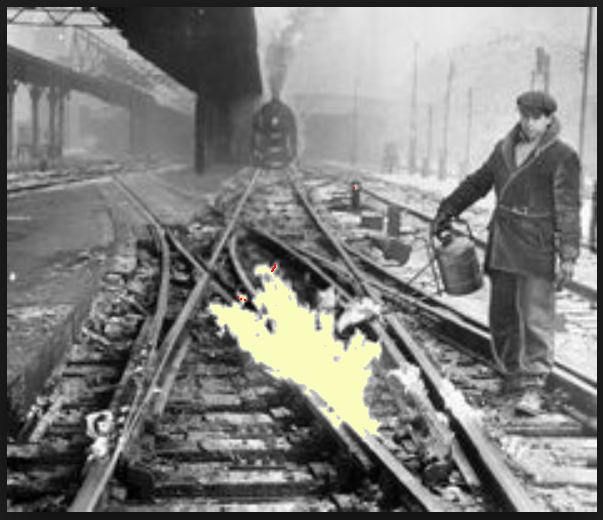
It was just a few weeks before I was born that Daddy was injured on the railroad. Christmas Eve, 1945 was a really cold night, and Dad was flagging cars and maintaining coal oil lanterns on switches in the CB&Q switch yard. He had also started several small fires to thaw frozen switches so the trains could be routed onto the correct tracks.
Tending Switches
It was just a few weeks before I was born that Daddy was injured on the railroad. Christmas Eve, 1945 was a really cold night, and he was flagging cars and refilling coal oil lanterns on track switches in the CB&Q switch yard. He had also started several small fires to thaw frozen switches.
As daddy was walking alongside a moving train to the next switch, something struck him in the face, nearly knocking him off his feet. Apparently, an object was sticking out from the side of one of the passing rail cars and it struck him in the head. He said his face was so cold that whatever it was jarred him, but didn’t really hurt.
It wasn’t until he realized he could stick his tongue through his left cheek that he knew he was cut. He took a taxi to the hospital to get the wound treated, but wouldn’t let them give him a sedative, because he wanted to go back to work. He didn’t remember how many stitches were required, but said it was, “A lot.”
He commented that it was so cold that night, once he got back to work, the cold numbed his face, and he didn’t feel any pain for the rest of his shift. The resulting scar began just below his eye and continued the entire length of his left cheek.
Early Labor

Mother told me about her early labor, brought on because of the accident, and the fear she had that I would be born too early.
But all went well, and I began my life as a whopping, healthy, eight-pound baby with curly blonde hair and bright blue eyes.
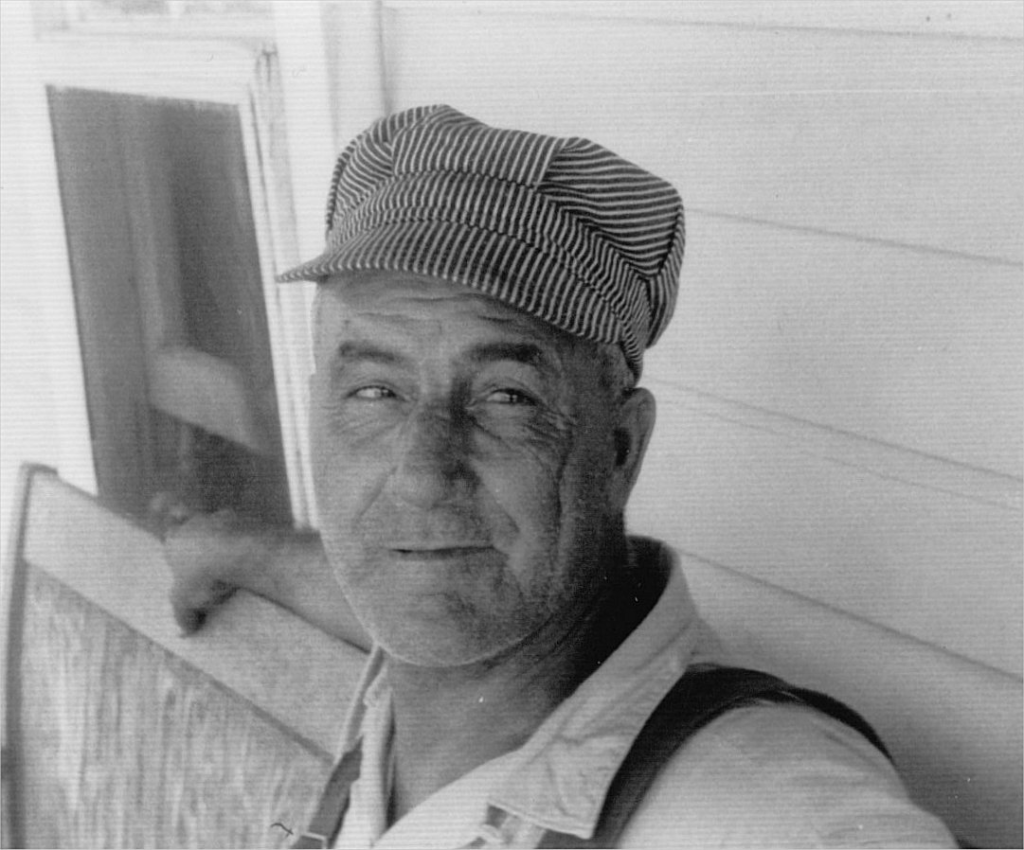
This photo is of me, Mother, and my Aunt Maggie, daddy’s sister, Margaret Tate Hawkins, in 1946. The location is unknown, but probably one of those streets along Bear Creek on Ely. Those streets were destroyed by the flood of 1993.
The Houseboat

Left: Daddy teasing me with a baby bottle.
This is the only known surviving photo of the houseboat I was born in. Notice the tall door sill, and the tall step up to reach it. The construction technique used is not that of a professional carpenter, which tends to lead one to think this was one of the thousands of homemade boats constructed during the Great Depression when Americans took to the rivers to move nearer industrial centers and potential work. Many families floated downriver and managed to get their houseboats up on dry land where they served as homes for many years. My family’s rented houseboat was destroyed by the flood of 1947, and we received emergency assistance from the Salvation Army.
Houseboat Aground

Example of a homemade houseboat circa 1930 courtesy http://peoplesriverhistory.us/project/history/
I became “Sis” to my brothers, and “Sissy” to Mom and Dad, and most everyone else in the family. That nickname has stuck to this day.


1948


Roy, holding Leona, Pauline, front: Robert and James
Location unknown, 1947
Hannibal Flood of 1947
It was in the spring of the year following my birth, June 1947, that the flood waters of the great Mississippi River took our home, all of our belongings, and almost took my brother Jim’s life.

I will try and recall the story as Daddy told it to me. Daddy awoke in the middle of the night during a huge thunderstorm and found floodwater had already entered our small home. Bear Creek is a branch off the Mississippi, and where we lived on Ely Street was not far from the river. The water was knee-deep on Daddy and was quickly rising.
Dad knew flash floods come fast, are silent at first, and turn very dangerous very quickly as the water gets deeper and starts plummeting to lower ground. He yelled for Mother to grab the baby and run! Daddy took my brother Jim from his bed, holding him close to his chest. He woke Bob, told him to take his hand and to not let go!
The waters were almost waist deep by now, and very swift. Mother was in front, holding me above her head as she hurried to higher ground. My brother Bob’s head was barely above the water and Jim was clinging to Daddy’s neck. Dad reached down to pull Bob up into his arms and as he did, Jim was swept from his grasp. Holding desperately onto Bob, he dove into the dark, debris-filled waters, searching for Jim.
It wasn’t until his third dive that he managed to grab onto Jim’s foot and free him from the rapidly moving water. Jim was gasping for air, and was very happy to once again have his arms around Daddy’s neck. Mom and Dad said it was only through the grace of God that Jim was saved. Flash floods have undercurrents and can carry someone away in a second. It was a miracle that Jim was only a few feet away from where the waters had snatched him.
Mother said she was really sad to have lost the few family pictures she had, but other than those, everything else could be replaced.

As I remember them relating this terrifying story to me, I am amazed that at the end of it all, life, and the fact that we were still together as a family was really all that mattered.
Neither of them talked of the horrible fright, the loss of all their personal belongings, or any bad feelings they had because of it; only of how grateful they were to God that we were all saved.
After the flood, our family moved to an upstairs apartment above the Kroger grocery store on a corner of Main street, downtown Hannibal, where we lived until I was about four years old. The address was 311a North Main.

Living Next Door to the Cooks
Being very young during these years, I am not sure of the things I truly remember or if my memories are simply of stories I have heard. I do recall that our home was in a very large building, and my Aunt Lizzie (my Dad’s sister Elizabeth) and Uncle Harry Cook lived upstairs, too. They had a son Paul who lived with them, and two daughters, Goldie and Dutch, who were married and no longer lived at home.

Robert, Leona, James, 1947 on an unknown dirt road
The stairwell leading from inside the door off Main Street was very steep and high and the landing at the top had a wide, long hallway with a railing of turned wooden spindles. Seems I recall this mostly from watching grown-ups going down the stairs to leave. I was never allowed to go down the stairs without an adult. Main Street was very busy and too dangerous for young children to go alone.
We shared the only bathroom with the Cooks. It was at the end of the long hallway, opposite the stairs, which always seemed very dark and frightening to me. I always waited until I could wait no longer, then I would run as fast as I could down the hall. Mother always laughed at me for being so scared of what she, of course, saw as nothing to be afraid of at all.

I remember there were rats that scurried along the baseboard, to where I did not know. Daddy said that they lived in the building because of the grocery store below and that they would not hurt me. I do not remember that I was particularly afraid of the rats then, but today I would really be frightened. My brothers, Bob and Jim, and I would play in the hallway when it was too cold or rainy to go outside.
When the weather permitted, we played behind the big brick building we lived in. There was no grass or trees. Our play area consisted of a small paved lot where the store’s trash cans were kept, an alley, and an attached lot on which there was a building that was partly torn down.
There were piles of bricks and boards from which you could climb down into the basement of the dismantled building. Of course being the girl, and the littlest of the threesome, I was often left behind to do my own thing as Bob and Jim raced ahead.
Mother and Lizzie hung their clothes from a line that stretched between the rubble of the adjacent lot and the grocery. They would often have me retrieve clothespins they accidentally dropped into the basement. I do not know why I remember this so vividly, unless it was the pride I felt in being able to help.
Canning Food

One of the benefits of living above the Kroger Store was that every evening the produce man would bring us the fruits and vegetables he cleared from the produce aisle; the ones that were too ripe to leave for customers to purchase the next day.
Mother and Aunt Lizzie would go through the basket he put together for us and retrieve anything that was worth saving. The rest they tossed in the store’s garbage bin out back.
We always had lots of ripe bananas and apples for snacks, and some of the produce was put aside to be cooked the next day.
The rest of the fruits and vegetables, Mom and Aunt Lizzie would can in glass jars. Canning is a method of preserving food in an airtight container which provides a shelf life ranging from one to five years.
Also known as “putting up” food, canning is used for fruits, vegetables, and, even, meats, by packing them into glass jars and then heating the jars to kill the organisms that would create spoilage. It is a practice still in use today by many home gardeners.
The fruits they used to make pies, applesauce, and jams & jellies. One of my favorite jams Mother made was Pear Honey. It was very sweet, with chunks of pears and pineapple. One of my least favorites continues to be overripe bananas. I like them fresh and firm, before the produce man would decide they couldn’t be sold.
Riding the City Bus

Bob was now in school, and rode the city bus to and from school each day. Hannibal did not have school buses in those days, and students rode the city bus back and forth. I believe he went to Central School at the top of Eighth Street. He had special tokens that he purchased from the bus driver, which I believe cost five cents each. Jim and I always wanted to ride the bus too, but never got to.


In August of 1949, our Grandpa Fred Tate passed away. Grandpa Leffert passed away in February of the next year, only six months later. This is the last photo we have of Grandpa Fred, taken Christmas 1948.
Gene Autry

One of my fondest memories was one summer day sitting in our bay window, which overlooked First Street, with the Mississippi to my left (east) and Main Street to my right (west). We saw, parked below us a bright red convertible, Gene Autry (a famous cowboy movie star of the time) and his clown, Jingles, were sitting inside the beautiful car waiting for a parade to begin. My brothers say it was a 1948 Cadillac.
Mother opened the window and we called down to them. Gene Autry was dressed in a black western costume with lots of sequins and long white fringe. He worn a big white cowboy hat and looked up at us with a huge smile. Jingles threw us candy and jumped all over the car doing silly tricks. We were so excited!
Later, as we watched the parade from our upstairs screened-in porch that overlooked Main Street, Gene Autry yelled, “Hello,” and called our names as he went by. We felt very special that day, and talked often of the event for a very long time.
Mother and I would sit on the screened-in porch in the afternoon and fold the laundry. This was fun for me, and was a special time that just she and I shared. Of course, I was always full of questions and this seemed to be the time she could take time to talk.
One day a wasp stung Mother on the arm, her arm got great big and red, and I could tell it really hurt. I was so sad that she got hurt! When Daddy got home from work, he took her to get help. The doctor gave her a shot of anti-histamine, and told her that she was allergic to wasp and bee stings.
Grandparents

Sweet Cherry Tobacco

My grandfathers, Fred Tate and John Leffert, came to live with us, and even though I don’t remember them very well, I can still recall the smell of their soft flannel shirts. It was a sweet cherry scent that came from their pipe tobacco. Daddy said they came to live with us because they were ill and unable to care for themselves. At one time they were both living with us.
I can remember Grandpa Tate dressed in a long, white, nightshirt, lying in a white bed, and Mother telling us we should play quietly because he needed to rest. His death certificate indicates that he resided at 116 Center Street, but I think that may have been the address of a nursing facility. Grandpa Leffert definitely lived with us when he died, as his death certificate shows his home as being 311a Main Street.
Mother told us that Grandpa Fred Tate got up early one morning and built a fire. However, instead of putting the wood in the stove, he put it on the wood floor under the stove. She said that it was quite an exciting way to wake up. What a commotion there must have been!
My grandpas died within six-months of each other and are buried at the Hester Cemetery, close to the Homeplace. Grandpa Tate died in August of 1949, and Grandpa Leffert died the following February.
I never knew my grandmothers. Amanda Elizabeth Leffert, my Dad’s Mother, died in 1938 of gangrene poisoning in the left leg. Family tradition is that the infection started with a tomato plant rash. She is buried in the cemetery at Hester.
My mother’s mother, Blanche Roberts Leffert, died on the operating table in Indianapolis in 1933 of Peritonitis of the abdomen. She is buried at Farley Cemetery at 106th and Keystone in Carmel, north side of Indianapolis. We have several ancestors and relatives interred in that cemetery, including Farley, Roberts and Michener.

Larry Davis Tate
Mother left us once with Aunt Lizzy and was gone for several days. It was wintertime and I simply could not figure out why she would leave me; she had never left before. I can remember crying and crying and Aunt Lizzie would tell me that Mother would be home soon and that she would be bringing me a new baby brother.
I just couldn’t understand why I needed another brother! I already had two! Larry Davis, born December 3, 1949, arrived home with Mother a couple of days later. I’m sure he was a precious baby boy, however I really don’t remember; all I cared about was my Mom was back home. She cried, and she said she missed us so much! I was a happy camper again.
Main Street, Hannibal – 1950

Riverfront Action

One of my favorite pastimes was sitting in our bay window and watching all that went on below. I could see the Mississippi River to the south, and watch the towboats and barges make their way up and down the river. The CB&Q Railroad ran along the Mississippi riverbank, and the huge steam engines with their big bellowing smokestacks sped by day and night.
Sometimes we could see Daddy and “The Gang” working on the tracks. And then there was the hustle, bustle of Main Street itself. Seems there was always something going on there. In the evenings we would all sit on the screened in porch, where it was cool, share stories and watch the people below. Back then a lot of families walked in their neighborhoods in the evenings.
Hannibal’s River-Side Park

Our family would often walk to Riverside Park, which was at the end of Broadway, right on the Mississippi river. The walk was always so much fun, skipping along Main Street with my brothers, Mom pushing Larry in his stroller, and Dad trying to keep us all close by. It was a beautiful park with soft green grass to roll in, and huge shade trees that lined a circular sidewalk. We were allowed to run and play, sometimes the whole afternoon.
As evening came, the beautiful water fountain in the middle of the park would light up with pretty colors. We would sit and try to guess what the next color might be. The time would pass so slowly, it seemed, and yet when Daddy would say it was time to leave, I would always think it just couldn’t be time!
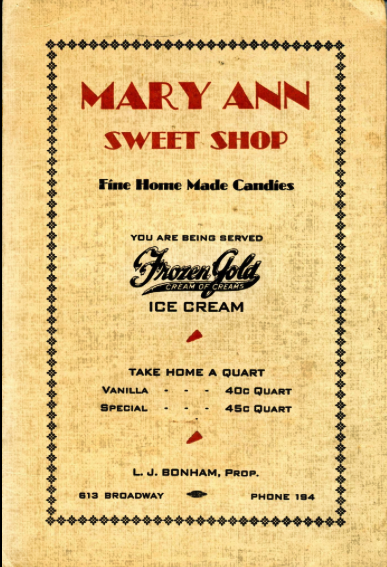
He could usually get us ready to go quickly by with the promise to stop at the Mary Jane Sweet Shop on the way home. I will never forget the smell as you entered the shop. It was heavenly! A luscious smell of freshly popped caramel corn. The shop was lined with a long glass counter with numerous compartments; each filled with a different delicious candy. We would each get a nickel to spend, which doesn’t seem like much now, but in 1949 you could buy a whole pound of candy for a dime!
My favorite was spice gum drops. My brothers would usually buy chocolate candy, jawbreakers, or caramel corn. Mother would sometimes buy salted Spanish peanuts. She and I would usually share and eat the peanuts and spice gum drops together, something I still like to do today!
Cousin Constables
My cousins; LeRoy, Mary Ellen and Gary Constable lived at the corner of Munger Street and Ledford Streets, which was about three blocks away. I resented my brothers having all that freedom. Before we moved they were always there and now I was left alone to play. Sometimes they would bring their new friends home to play, but even then I was ignored. I was just their little sister, and the boys from the neighborhood were much more fun to play with.

Jim Tate, Mary Ellen & Leroy Constable, and Leona Tate – 1949
I think it was the summer of 1950 that my family moved to 1220 Colfax Street. I do not know the reason we moved, but I believe it was so my brothers would be closer to school. The house had a front porch with steps to get to the front door, with a porch swing to the right of the door, just in front of a big window.
There was a fenced in backyard where I could play and it even had grass and trees! I was four, and was not allowed to leave the yard. My brother Bob was nine, and he would take my brother Jim, age 6, to play with the neighborhood kids.

We did have a lot of company that summer, and picnics in the backyard. I was getting really big and I helped Mom a lot. I did dishes, picked up toys and papers when she was cleaning, helped watch my little brother Larry, folded laundry and even helped her can peaches and beets. She would soak them in very hot water, then put them in cold water, and I would then peel away the skin. I can remember thinking how smart she was to know how to do this.

When school started that year, my brothers, Bob who was in the 4th grade and Jim, who was just starting school, was in the first grade, went to Eugene Field School on Market Street. I was really sad at first, but quickly learned it wasn’t so bad, because Mother and I almost always had some special time together in the afternoons while Larry was taking his nap. It was really great having Mother all to myself!
We played Jacks, Pick-up Sticks, Tiddly Winks, and Old Maid Cards, colored pictures and put puzzles together. She loved to work on puzzles and was very good at all the games. We read books and I really liked The Three Little Pigs and The Three Bears, I memorized these books and would read them to Larry.

Roy Tate Family, Christmas, 1951: L-R: James Wesley (Jim), Leona Marie (Sis), Roy Davis, May Pauline with Larry Davis, Robert Leroy (Bobbie)
First Solo Trip to the Grocery Store

The winter came and went and it was soon warm enough for me to play outside again. One day Mother asked me to go to the grocery store for her. It was a little neighborhood store, Hamilton’s Grocery, on Ledford Street, just across from where my cousins lived. In those days, before supermarkets, practically every other block of a street had a small grocery store.
The store was often about the size of a long double garage, sometimes built onto the front of a residence. If you couldn’t find something you wanted at one store, you could walk a couple of blocks and find it somewhere else. The most helpful grocers would call other stores to see if they had the item.
I do not remember what Mother sent me to get (probably a pound of bologna), but I remember repeating it over and over on my long walk, so I would not forget what I had been sent to get.
I was really scared, and could not believe my Mother would let me go all that way by myself! The store was owned and operated by Mrs. Hamilton, a lovely older lady, who always had a smile that showed off her gold tooth. She wore a long white apron and was always very busy. She greeted me as if she, too, was surprised I was alone.
She filled my order, handed it to me, and said I could choose a piece of candy. Wow! Now I was really excited and could hardly wait to get home and tell Mother. She was anxiously waiting on the front porch for my return and seemed very proud of her little girl.
It was much later that I learned she had called Mrs. Hamilton and told her I was coming, and she had watched every step I took from the back stairs. I did wonder at the time how she knew I had run all the way back, but mothers know things like that.
As I made more and more trips to the store, Mother knew she could trust me to follow the rules: Always stay on the sidewalk, stop and look both ways before you cross the street, never talk to strangers, don’t play along the way, and never stay long and waste Mrs. Hamilton’s time. Then of course, come straight home.
Sometimes Mother would even let me push Larry, who was about 18 months old, in his stroller to the grocery store. Oh boy, did I feel big! Of course, now there were even more rules to follow. “Don’t go too fast, be careful of the cracks in the sidewalk, don’t be silly or childish, you must be very grown-up when you have the baby. Larry can have a piece of candy too, but be sure it is something soft or maybe a sucker, we don’t want him to choke.”
“Oh, yes, and make sure he keeps his hat on.” It seems there were more and more rules each time Larry would go with me and I would think that I would never be able to remember ALL the rules. But it got easier and easier, and Mom was very proud when I could tell her the rules without any coaxing. I’m sure she watched me from the back steps and worried every minute I was gone.
Entertaining Larry D

As winter came, I had to once again play indoors, however Larry was getting bigger, and I found it was fun to entertain him.
I helped Mom every day with Larry over the next few months. I could make him laugh, I taught him a lot of new words, I read him lots of Little Golden Books, which by now I had learned all the words or had memorized them from Mother reading to me, we drew pictures and colored in our coloring books.
But my favorite playtime activity was to dress him in all sorts of old clothes and have him model them for Mom. She would make fun at the sometimes ingeniously funny, costumes I came up with. I’m sure Larry hated every minute of it and would have much rather played with his cars and trucks, tossed the ball, or wrestled!
Mother’s tummy started growing, and she told me that there would soon be yet another baby in our family. I can remember thinking, “How can I get two babies to the store and back!”
1951 Pre-School
That winter Mother started telling me more about school, I memorized the alphabet, learned to write all the letters, and even my numbers. All the things Mom said would be important when I got to school. She taught me to write my name, learn my address and phone number, and all of a sudden it became very important to always color inside the lines. Bob would draw me pictures to color; he was a really good artist and rarely had to erase any lines.
Of course, once I was told I would soon go to school it was suddenly my favorite thing to play. So when my cousins came to play, they all had to pretend they were in school and follow my every direction. I would grade their work, just as Mother graded mine. I was sure that I knew everything there was to know, and really couldn’t understand what the big deal was about going to school.

Daddy helped me, mostly with the alphabet. He told me that if I practiced hard enough I would even be able to say it backwards. A feat I never accomplished, but Daddy could say the alphabet just as well backwards as he did forward. I couldn’t figure out why he thought that it was so important. Not one of my teachers ever asked me to say the alphabet backwards. But I guess they must have in the little country school in Taylor.
Carl Wayne Arrives
On March 26, 1952 Mother gave birth to my fourth brother, Carl Wayne. I was really anxious for Mom and baby to get home. Since I had been helping with Larry so much, I knew I was really going to be a big help with Carl. But, when she came in carrying a tiny little bundle of blankets, I could not imagine that there could be a baby inside! When she uncovered him, I laughed and said, “He sure is funny.” He was long and skinny and had bright pink skin.
He started crying very loudly and his bald head got really red! He didn’t have any teeth and kept sticking out his tongue. His toes and fingers were very tiny, his skin was all wrinkled, and he had an ugly black thing on his stomach. But, he changed quickly and became a very cute baby.

Pauline and Carl, 1952
Larry and I became Momma’s little helpers and loved to fetch things for her and the baby. We played with the baby so he wouldn’t fuss when Mother was busy with her household chores. Carl could soon laugh at our antics and rarely had to cry because Larry and I would run and fill his every want or need. He was a very spoiled baby!
1207 Ledford
It wasn’t long after Carl was born that we moved again. All of us kids (especially me) were very happy because we were moving right next door to our cousins at 1207 Ledford in Hannibal. It was a big house that had been made into a duplex. The Constables and our family shared a bath at the back. Our cousins, Leroy was 8, Mary was 4, and Gary was just a baby. Aunt Clara and Uncle Charlie Tate lived just behind us at 404 Munger Street. Our back porch was just a few feet from their yard and Mother and Nellie Constable would visit frequently over the fence.

Hamilton Grocery Store
There were lots of other children in the neighborhood. I had already met most of the kids from when we visited Aunt Clara and Uncle Charlie or Nellie and Everette Constable. Also from the few times my brothers would let me tag along with them. The Hamilton Grocery had a big concrete porch in the front of the store, with old iron pipe railing all the way around. This became the place for the kids to hang out.
Mrs. Hamilton didn’t care as long as we kept reasonably quiet and didn’t wrestle. The lot of us would spend hours on this porch, swinging from the railing and making plans. Right next to the store was a big empty lot, I don’t think I ever knew why there was no building there, but chances are that something had burned down sometime over the years. I was finally part of the group and the fun and games that I had heard so much about from Bob and Jim.
It was in this empty lot that we got to play rough. We often played Hide ‘N Seek, and of course, I was one of the youngest players, it seemed like I was seeking more often than hiding.
Mrs. Hamilton lived with her daughter, Mary Katherine Hess’ family, in a house attached to the rear of the store. Mary Katherine had three children, Arkey, the oldest boy, was the same age as my brother Bob. His full name was Arthur Marion Frances Lawrence Hess. What a mouthful! My brothers would tease him by calling him Marion or Frances, and he would get really mad and chase them around the neighborhood. The daughter, Barbara, was Jim’s age, and the youngest was a boy named David, who was my brother Larry’s age. They attended a Catholic church.
Kimberlee Kay Robinson
I had a girlfriend named Kimberlee Kay Robinson, an only child who lived in the house next to the empty lot. She was a quiet little girl and rarely took part in our outdoor activities. She was my age, but much shorter, and was plump, and had a pretty face, big blue eyes, and quite pretty dark blonde hair.
When I went to visit her we would play with her large collection of dolls, or play with paper dolls. She had a cat that we would dress in doll dresses, hats, and even shoes! The silly cat didn’t even care, and after we had it dressed, Kim would say, “Show us your stuff,” and it would parade around as though it was in a fashion show.
Kim’s Mom would make us cookies and we would have tea parties on her back porch. He Mom would also read to us and help with our writing and coloring. Kim and I would soon be starting school, and her Mom was a teacher, so we had lots of questions to ask about what our day would be like.
Questions like, “what if we don’t like our teacher?” “Will the other kids like us?” “What will we do if we get sick?””Can we come home if we don’t want to stay?” Kim was a good friend, and I really enjoyed the quiet times we spent together. Our house was never quiet!
Jerry Stover
Walter and Maxine Stover lived next door to us, and they had three children. The oldest was Sharon, who was two years older than me. She had really dark hair and skin color. Her eyes were dark brown and she seemed really grown up to me. Her brother, Jerry, had Cerebral Palsy. He was really nice, and always had a big smile on his face. He was in a wheelchair, and had braces on his legs.

Maxine had to help him a lot, and he had a routine of exercises to do every day. Sharon and I would entertain him by doing silly little plays, songs and dances. He was a real good sport and always laughed at our silliness, or clap his hands when we performed. The photo is Jerry and Maxine.
Half A Happy House
Our half of the house consisted of only three rooms, which were arranged one behind the other along Munger Street. There was no yard on this side of the house, only a sidewalk and then the street. Our front door was off of Ledford Street and there was only a small landing and a sidewalk there too. Upon entering the front door you were in the kitchen, a medium-sized room, perhaps, 14 feet by 16 feet.
The dining table sat in the middle of the room. It was a rather large wood table with lots of mixed and unmatched wooden chairs surrounding it. Some of the chairs were painted white, some were ivory, some were a medium green, and some chairs were not painted at all, but different shades of natural wood.
Hoosier Baking Center

To the right of the front door was a Hoosier kitchen cabinet. It was painted white and had a metal countertop. It was designed to make the homemakers’ baking chores easier by bringing everything needed for baking into a central location.
There was a metal bin that could be tilted out in the upper right-hand compartment designed to hold and dispense flour. Mother would keep it filled with all-purpose flour.
At the bottom of the flour bin was a flour sifter, used to remove lumps and the occasional insect. Sifting loosens up flour that has been sitting around in storage for a while, aerating it and helping your baked goods to have a lighter texture. Mother would always let me sift the flour for her when she made bread.
The upper left-hand compartment of the baking center held a sugar bin, and the center one held containers of salt, spices, and baking powder. On the inside of the doors, there were printed cards with measurement conversions, recipes, and other household tips.
Radio Mystery and Adventure

The radio sat on the top of this cabinet and Mother would listen to Soap Operas while she worked. “As the World Turns,” “The Guiding Light,” “Secret Storm,” and “The Edge of Night” were her favorites.
The radio was an important part of all our lives at that time. We did not have television, so the radio was our source of news, weather, school closings, as well as programs we listened to in the evenings for entertainment.
My brothers and Daddy would sit around the kitchen table and listen to baseball games (they were great St. Louis Cardinal fans) yelling, cheering, and sometimes hitting the tabletop in disgust. Mother and I would laugh sometimes at how they were going on about the game.
As kids, there were a number of programs that we loved to listen to such as “The Lone Ranger,” “Shadow,” “Gun Smoke,” and “Have Gun Will Travel,” were just a few. Daddy loved to hear “The Amos ‘n’ Andy Show,” as well as, “Dragnet.” We all looked forward to the Lux Theater dramas, and, of course, Saturday nights the highlight of the day was the Grand Ole Opry.
The commercials were very entertaining too. Most had a catchy jingle or song, and we would all sing along. Ivory Soap, Buster Brown Shoes, Wrigley’s Gum, Philip Morris, Johnson Wax, Bromo Seltzer, Coca-Cola (it was called Coke at that time), and Burma Shave were some that I can recall.

Buster Brown’s song was, “Does your shoe have a boy inside? What a funny place for a boy to hide! Does your shoe have a dog there too? A boy and a dog and a foot in a shoe. Well, the boy is Buster Brown. And the dog is Tige, his friend. And they’re really just a picture but it’s fun to play pretend. So look look look in the telephone book for the store that sells the shoe, with the picture of the boy and the dog inside so you can put your foot in too. Buster Brown Shoes!”
We would sit around the kitchen table listening so intensely and be really scared of what would happen next to our favorite characters. Others times we would laugh at the silliness that went on. It was amazing how lost and involved we could become in the noise that came from that little box.
Playtime Activities
We would often put together a puzzle, play cards, checkers, dominoes, pick-up sticks, Chinese checkers, color, or even do homework with the magic of the radio filling the room. Our favorite card game was “Authors”; each card had a picture of a famous author on the front.
I don’t remember all the rules now, but only that we would sit in a circle on the floor in front of the coal stove and sometimes play for hours. Monopoly was my brothers’ favorite board game and of course, I played but was not really that interested in the strategy of the game. Could be that my brothers were just so good, and I always lost or that it just took too long to play.
Mother was a master at Tiddly Winks and Jacks and never showed us any mercy! But we didn’t care because we always had fun. On weekends when our friends and family visited there would be three or four games going on at the same time.
Card Playing Through the Night
Daddy loved to play double deck pinochle and sometimes when his brothers, cousins, or friends would come over they would play the whole night through. I learned to play the game before I even started school. I would sit on Daddy’s lap and watch his every move. I easily picked up on the strategy of the game and became my Dad’s partner.

Aunt Betty, Daddy, Leroy Constable, Carl, Kathy, Gale, Mom, Larry D, Dennis, Uncle Charlie Leffert
Mother did not like to play cards as Daddy’s partner because he was always so serious about the game and did not like it when you got distracted and missed an important play. He really was not a very good loser.
I think this was because he was such an expert player, he couldn’t understand when his partner would make silly mistakes. He would rap his knuckles on the table with every discard, especially if he was taking a trick. He sure did like to win!
Straight Razor Shaves

In one corner of the kitchen there was a small table that held a wash pan, soap dish, and Daddy’s cup, which held his shaving soap and brush. Over the table hung a square beveled mirror with flowers in the corners and a scalloped edge. On the wall next to the table there was a metal towel rack. This is where we washed up before meals and where Daddy shaved.
I loved to sit and watch him shave. He would put a little warm water in the shave cup with the soap and use the brush’s bristles to make a bunch of lather. There was a leather strap that hung from the table and he would always sharpen his straight razor before every shave. He would wet a washcloth with very hot water and hold it over his cheeks, he said this was to soften his whiskers so the razor would cut well.
I loved to sit and watch the procedure. We shared stories and he would try and answer the numerous questions I always seemed to have. He said I was the curious one! He usually shaved after supper and I would be full of news of the day.
I’m not sure why he shaved in the evening, but I think it was because he worked outdoors and his face would chap if he shaved in the morning. And then there was the fact that Mother didn’t like his sticky whiskers, and he knew that if he were freshly shaven, Mother would be more likely to kiss on his face.
Coal-Fired Heating Stove

The kitchen sink was in the middle of the far wall. The window above overlooked Munger Street, but since we lived right on the corner, Mother could see down Ledford and even into the empty lot where we played. The room next to the kitchen was a large room (perhaps 20 x 20 feet) that we used as a combination living room/kids bedroom.
There was a large coal stove in one corner that sat on a big square metal plate, which I assume was to protect the floor from the heat of the stove and any ashes that might be dropped when cleaning it out. There was of course a bucket of coal and a coal shovel there too. Bob and Jim were responsible for keeping the fire going. They had to remove the old ashes and carry them away, as well as bring in more coal every evening.
Bob and Jim shared a bed, and I slept with Larry in his crib. Later I got my own bed, which was very small, probably a youth bed, but it sure was good to not have to share. There was a small game table and chairs in the room too, as well as two cushioned chairs and a rocker. Between the two big windows looking on to Munger Street sat a huge wooden wardrobe. I do not remember a dresser, but I’m sure there must have been one or two.
Shortly after we moved into that house Uncle Charlie Tate papered the room. The paper Mother had picked was white with huge, bright pink roses. Each rose must have been as big as a dinner plate, with lots of green leaves and stems. On evenings I could not get to sleep I counted roses instead of sheep!
You had to go through their room to get to the bathroom, which was a small room (8 feet x 8 feet), and was very bright and cheery. There was light pink wallpaper with tiny flowers and the woodwork was painted a bright white. There was a small window, but I had to stand on the toilet seat to be able to see out.
Next to the bathroom was the Constable’s kitchen. It was a long narrow room that extended the length of the house. There were two back doors, one of which opened onto the big back porch and the other at the end of the room that opened into the yard on the side. The cooking area was on one end of the room and the table and chairs were at the other end

The next room was Mother and Daddy’s bedroom; it was much smaller (probably 10 feet x 20 feet). There were no windows in this room and it always seemed dark. In this room there was a table by the bed, a dresser, a smaller wardrobe, and a chair for Daddy to sit while he got dressed. They shared their bed with the baby, Carl.
Aunt Clara and Uncle Charlie Tate

Aunt Clara and Uncle Charlie Tate’s fence was just a few feet from the back porch and there was lots of visiting that took place over that fence. Mom and Dad liked to sit on the back porch in the evenings, because it was cool, and away from all the commotion of the yard with 6 to ten kids playing.
There was an even bigger porch that went part way across the front of the house, turned the corner and continued down the side of the house along the yard. There was a wooden railing on this porch and a number of odd and end chairs and rockers. This was where everyone gathered in the afternoon when it was hot.
There were only two or three trees in the yard, but they were big, and supplied plenty of shade. It was a nice sized yard, even for ALL the kids that lived there. Let’s see, there were four of us (not counting Carl, because he was just a baby and too little to play in the yard) and two of our cousins (not counting Gary, because he too, was just a baby). Six kids! What fun we had!

In the back corner of the yard was the coal shed, which had a tool shed attached. The clothesline ran along the back fence, from the corner of the back porch to the corner of the coal shed. It seems there were always clothes hanging on the line, and we always had to be careful not to touch and soil anything.
So, most times when we came home from school Mother would say, “You can’t play until you bring in the clothes!” Mother and Nellie would often sit on the porch with their babies, fold clothes, and watch us play for a while before they started supper. We always called the evening meal supper, and lunch was called dinner.
Dressing Chickens
Two or three times each year Nellie and Mother would dress chickens (no, not with clothes). This meant they killed the chickens, plucked the feathers off, removed the innards, washed them until they were clean, wrapped them in white freezer paper and placed them in the freezer, ready to be taken out and cooked when needed.
Daddy and Everette killed the chickens by holding the chicken’s head and swinging the body around quickly, which would break the chickens’ necks. They then would let the chicken loose, and it would fall to the ground and flop around, throwing blood everywhere. When the chicken stopped thrashing about, the men would tie the chicken’s feet to the clothesline, so the blood would finish draining from their bodies. Yuck!


Just imagine the clothesline running through the yard where we played, with all those dead hens hanging on it!.
I thought all of the dressing process to be very nauseating, and usually ran off to play somewhere else in the neighborhood. I especially didn’t like the smell of the wet feathers. Mother and Nellie had to dip the dead chicken into very hot water so the feathers could more easily be pulled. My older brothers and Daddy and Everette all had to help pluck the feathers. Sometimes it is better to be the little one!
What a mess the process caused! The backyard had to be washed down with the hose and we were not allowed to play there until it was completely dry. To the parents it was simply something you had to do. There were a lot of mouths to feed. Both Daddy and Everette worked for the railroad and I’m sure did not make very much money.
And even though I did not help much with dressing the chickens, there were a number of other things I did to help that the boys didn’t do. I helped make beds, do dishes, can fruits and vegetables, set the table, and help with Larry (he was three years old now) and the baby (Carl was crawling now and followed Mother around like a puppy).
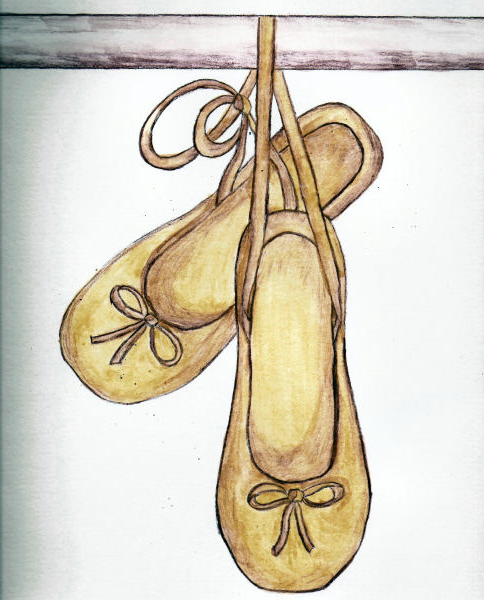
Note: Ballet Shoes
This pencil sketch of ballet shows was drawn by Lea as a young girl. It was on rough paper that was textured like construction paper. It was hung in the Homeplace bedroom as a decoration, and hung, along with Lea’s chicken drawings on the wall for many years. The paper was crumbling when we retrieved the drawings and got them digitized so they could be preserved. The originals disintegrated long ago.

Mary Ellen Constable
The Constables living room was next to their kitchen. Their front door was on the side porch and just inside the door there was a steep staircase that went straight up. At the top there was a room on either side. The room on the left was LeRoy and Mary’s bedroom and the one on the right, which overlooked Ledford Street was a large playroom where all the kids toys were stored, and where we played when the weather did not permit us to go outside. We shared everything.
Mary and I had a small table and chairs for our dolls, a play high chair, stove, sink and refrigerator and a small doll house in our area of the room. This playset was made of thin metal and were decorated with enamel paints. We would spend hours at a time playing with our dolls in that room, pretending to cook and keep house. My favorite dolls were Paul and Paula, boy and girl twins. They had soft rubber bodies with a harder rubber head. I had named them after my Mother, Pauline. My uncle Charlie Leffert often called my Mother Paul, or Paula.
Most of our toys were just cheap dime store stuff that we bought at the Ben Franklin Five and Dime or the S.S. Kresge store on Main Street. There were no Wal-Marts or similar stores when I was little. Toys were made of metal or wood, because plastic had not yet made the toy scene. During World War II most toy factories were turned over to war production. After the war plastic and metal toys became much cheaper and much more common. We took very good care of our toys, because we knew they would be difficult to replace.
My brothers, and cousin Leroy Constable, played marbles a lot. Of course, they had cars and trucks, baseballs and bats, and a kick ball. Mostly they rode their bikes, which were old hand-me-downs from someone. It seems that they were always having to work on those bikes. Mary and I played hop scotch on the sidewalk, skipped rope up and down the walk, spent hours cutting out paper dolls, coloring, and playing school.
Nellie and Everette Constable

Nellie and Everette slept in the bedroom downstairs, which was just to the right of their front door and next to the living room. That room always seemed dark to me too even though there were two big windows that opened onto Ledford. I guess Nellie must have kept the windows covered to block sounds from the noisy street below.
Sharon had a bunch of dress up clothes and makeup, and her favorite pastime was to pretend we were movie stars. I hadn’t been to many movies, so I hardly knew what she was talking about. But, I went along with her, and we always had a good time. She loved to dance and sing. She had a baby sister named Betty.
Hollyhocks and Catalpas

I remember that an alley ran alongside the Stover house and behind ours, where Charles and Clara lived. There were lots of Hollyhock flowers that grew in the alley and us girls would make dolls out of the flowers. Those that were fully bloomed were turned upside down and served as the doll’s gown. We would then take an unopened bud, leaving a short stem, which we stuck into the bottom of the open flower. This became the doll’s head. The Hollyhocks were all different shades of pink, white and burgundy. It was great fun!
On quiet Sunny afternoons when the boys were off doing whatever boys do, Sharon and Mary and I would sit under the shade tree, for what seemed like forever, playing with our hollyhock dolls, looking for four leaf clovers, and talking and talking and talking.
Our upstairs playroom overlooked Ledford Street, and the window opened onto the roof of the porch. From this window we could see any activity in the street and on the porch at the grocery store. My brother Jim often times climbed out of this window onto the porch roof and then jumped on a limb of a nearby tree. He would then climb down the tree and run off to play with someone he saw.

This tree was not a very big tree. I believe it was a Catalpa tree. As children, we called it a coffee bean tree. It has big leaves, and in the spring, big white flowers. After the flowers were gone, the tree would develop long green beans that hung from the branches. Us kids would pick the beans and break them into 1 or 2 inch pieces. This stained our fingers bright green, and it took several days for it to wash away.
After we had the beans broken, we would divide them up and stuff our pockets full. Teams were selected, and we would hide from each other. You had to get back to home base without getting hit by one of the beans. Boy, my brothers could really throw hard, and it hurt when a bean hit me!
It seems we made up lots of games back then. We had chores to do, of course, but the days were long, and we had lots of time to fill. We rarely went anywhere, and of course, we didn’t have a TV, or other digital devices, so we had to find things to occupy our time.
On the empty lot, we would play kickball, Red Rover, softball, dodgeball, and more. When the little ones would be with us we also played London Bridge is Falling Down, Ring Around the Rosie, Hide-And-Seek, and tag.
Collections

My brothers collected marbles and baseball cards. They were quite proud of their collections, and they traded their cards and marbles with other boys.
To play marbles, they had cleared a flat spot in the yard of all the the rocks and twigs. They stomped the dirt flat, smoothing it with their hands.
With a stick, they would make a big circle in the dirt. The more players, the bigger the circle. Most times it was four to six feet in diameter. This area of the yard was only used to play marbles. The boys didn’t like anyone messing with their play area and protected like it was sacred ground.
The object of the game was to knock marbles placed within the circle out of the ring with your shooter. Any marbles you were successful in knocking out of the circle were yours to keep. The one who won the most marbles at the end of the game was the winner two ways; first they won the game, and he had more marbles than the other players to add to his collection.
There were several special marbles for shooting. They were usually small solid colored agates that were harder than the glass marbles. Everyone had their favorite shooters. There were even metal ones!
To begin the game, the players determine the number of marbles each player would drop into the circle. Of course, then they had to decide what kinds of marble’s they would each drop. This was a big deal, because each person had their favorites.

There were “steelies,” with their shiny metal ball bearings from motors. “Moonie’s” were transparent with tiny bubbles in them. “Tiger’s Eyes” were mostly clear glass with a colored center shaped like a cat’s eye. There were clear glass ones of all colors. The clear red ones we called “Rubies.” Multi-colored agates were usually white glass with one or two colors swirled through them. “Patches” were white marbles with a patch of a bright color, and “Sunbursts” that were shades of gold, ivory and yellow.

There were bigger marble’s we called “boulders” and smaller than normal ones we called “Pee Wee’s.” I don’t remember how the boulders were used, but it seems all the boys had a few they were very proud of.
Most of the boys bought their marbles at the Ben Franklin Five and Dime store. They were sold in a small white cloth bag that had a drawstring at the top. To store their collection, they used glass jelly canning jars so they could keep them sorted by color.
The boys used hard cardboard cigar boxes to carry the marbles to games. Once the number and types of marbles were determined, each player would toss their marbles into the ring. To shoot, you place the knuckle of your index finger on the ring where there was a good chance you could hit some marbles out of the ring.
Placing your shooter on the inside of your knuckle, you use your thumb to shoot the marble into the ring, hitting as many marbles as you can, and knocking them out of the ring. I actually like to play marbles and my brothers would loan me marbles so I could sometimes play.
Their baseball cards they bought at the Hamilton Grocery store, the A&P grocery store on Broadway, or the five and dime store. There was also a little grocery on the corner, called Neiman’s, on Market Street close to Eugene Field School.

The cards came in a wax paper wrapper with a big square flat piece of bubble gum. They cost a penny a package in 1952. The cards my brother Jim most wanted were Babe Ruth, Stan Musial, Lou Gehrig, and Mickey Mantle.
Photo below is Uncle Charlie at age nineteen. He was scrawny, but a hard worker, and he was very musically talented.

Uncle Charlie Leffert stayed with us for a while before he married Betty Lou Majors. I remember him singing and yodeling while shaving. He always had a twinkle in his eye and a big smile on his face. My favorite song that he sang was Mockingbird Hill.
He and Aunt Betty were married on May 28th 1951 in Everett and Nellie’s living room at 1207 Leopard Street. Aunt Betty came down the staircase in her wedding dress for the ceremony. She was very pretty!
The Tate Homeplace
Other memories of our years on Leopard include our trips with Uncle Charlie Tate and Aunt Clara to the Tate Homeplace near Hester, Missouri. The Homeplace was a mere shack in the woods, but seemed like paradise to me and my brothers.

The two-room cabin was the birthplace of my Dad, Roy Davis Tate, and his Dad, Joseph Frederick Tate. The Homeplace cabin was surrounded by thick woods. There was a freshwater spring over the hill, a brook that ran around the property, and the Fabius River at the end of a path through the woods, where we fished, swam, and went frog hunting. The woods often yielded lots of mushrooms of all types. Moma would batter and fry them on the fire pit for a delicious side dish for whatever meal was next.
We watched deer cross right through the yard, red foxes playing on the hill, listened to the whippoorwills sing their songs, and heard the hoot owls calling. We chased blue tailed lizards, and sometimes we were chased by blue racer snakes.
We loved our weekends spent at the Homeplace. Of course, we had to help cut grass, clear the weeds in the yard, and cut wood for the heating and cooking stoves. But, we really didn’t mind. We loved being in the country. We hiked in the woods, played in the brook, swam in the river, picked blackberries, hunted for mushrooms, shared stories around the fire at night, played games, shot tin cans with a rifle, hunted frogs, fished and just got to be kids.

The 1960 picture above shows the shutters removed from the windows and leaning against the building. Notice the tin roof which dates back to the 1950s.
Aunt Clara’s blackberry cobbler, baked in the oven of the wood cookstove, was awesome! Mom’s breakfasts cooked on the open fire pit outdoors were unforgettable. The aroma of bacon frying filled the air and stimulated appetites. We always hurried and finished getting dressed and doing whatever early morning chores we had been assigned so we could sit down and eat.
There were soft, warm, feather beds on the old beds where we slept, and our covers were quilts that Aunt Clara and Mother made from worn-out denim overalls and other old clothes.
Daddy would always get up early and build a fire in the wood stove. It would get so hot in the room you had to get up to go outside and cool off! I think it was just his way of getting us out of bed early and outside to enjoy this beautiful site. He loved being at the Homeplace, and to this day, I am never there that I don’t feel his presence. It is truly his place on Earth!

Interior of the Homeplace bedroom containing four to six beds, as needed. Shown here, in 1971, L-R: Front: Larry Tate, Barbara Taliaferro. Rear: Kathy Tate, Pauline and Roy Tate. Leona’s 4th grade drawings of the hen and a rooster hung in this corner of the bedroom for several years from childhood until long after she was married.

Composite Sketch of the modern Homeplace, commissioned in 2013, by Mark David, showing the screened in pavilion, cabin and outhouse in a mature wooded setting.
Charlie Tate’s Track Gang
Dad did not drive, and rode to work with Everett, nicknamed “Slick,” and Dad’s brother, Charlie, to go to work. The work gang would meet each morning in the railroad yards at the east end of Main Street. Others in the gang included my uncle, Harry Cook, Oliver Baker, Arnold Campbell, my uncle, Earl Tate, and “PeeWee” Stover.
They were all great friends, and the long hard hours they labored on the railroad tracks of the CB&Q railroad were made easier because of that friendship, the jokes and the camaraderie they shared.
Uncle Charlie married Clara Stover. Uncle Harry married Amanda Elizabeth Tate. Uncle Earl Tate married Elsie Stover, sister to Clara.

Sometimes daddy would work as a signalman at a little wooden shed located where the railroad tracks crossed Main Street. His job was to stop car traffic to let the train cross. Sometimes he would let me go to the little shack with him, and I always felt very special that I got to watch him work, and to watch the big engines up close.

Dad was a dedicated family man. He never wavered. He loved without reservation, and laughed freely. His legacy lives on through his children and his extended family.

June 8, 1947 – Chicago, Burlington & Quincy railyard, Hannibal MO. View to the North toward Cardiff Hill and the lighthouse. The Bear Creek bridge is in the center.
Nicknames
My family called me “Sis” or “Sissy.” Other nicknames included “Bologna,” “Loney,” “Olive Oil,” and “Missy.” My cousin Mary was only two when we moved to Leopard Street, and my brother Jim, gave her the nickname of “Doodie Didee” because she always seemed to have a dirty diaper. This name stuck with her for years! All the guys on the track gang Daddy worked with had nicknames. Daddy’s was Doc, because someone got hurt, or ill, one time, and Daddy made up a concoction that made him well.
First Day of School
They did not offer kindergarten when I was a child. I was six years old when I went to first grade at Eugene Field School in the fall of 1952. My days before that were always spent with my Mother I can still remember how devastated I was that first day of school! She sat me at the table, in what seemed to be a huge room, and left. Of course, I was only one of several boys and girls that cried that day.
Back then most Mothers did not work outside the home. Children stayed at home. Starting school was pretty scary for a couple of days, but, our teacher, Mrs. Lorraine Mitchell, was an angel, and soon I loved that school. I took a sack lunch, and lots of days Mrs. Mitchell would let me sit with her in our classroom and eat lunch. My sack lunches were usually an egg sandwich with a cookie. We became great friends.
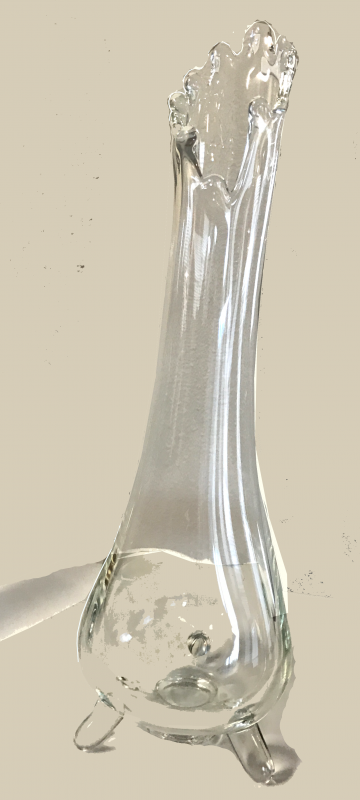
For many years, she and her husband, Jim, would pick me up on Sunday mornings for church. My brothers, Jim and Bob, cut her grass and did chores for her. When I married, she attended the ceremony. I still have the blown glass vase she gave me as a wedding gift. I was so fortunate to have her as my first teacher! She showed me how fun and rewarding learning could be. I suppose if I had gone to college, I would have tried to be a teacher just like her.
My other teachers at Eugene Field School were Mrs. Webber for the second grade, Miss Potter for the third grade, and Mrs. Webb in the 4th grade. Bob and Jim and I walked to school each day. We would cross Ledford and walk across the empty lot where we played, crossed the railroad tracks, passed the old casket Factory on Lemon Street, then up a really steep hill on Pearl Street. I think the street we turned on next was Houston, which ran along the east side of Eugene Field School on Market Street.
Levering Hospital

Hannibal’s Levering Hospital was directly across the street from the school. I distinctly remember this because there were a number of times I was a patient there and could watch my classmates playing at recess on the playground. One time, my whole class lined up on the sidewalk, each holding a big letter. The letters spelled “Hello Leona. Get well soon.” When they saw me waving to them from the window in my room, they all waved back, and then they were off to play.
First Neighborhood Television

In 1953 our family was one of the first in the neighborhood to get a television set. It was a Motorola with a small screen and black and white picture. Color television was not available. We had lots of friends come to our house to watch shows such as Groucho Marx, To tell the truth, The Red Skelton Show, The Ed Sullivan Show, Gunsmoke with James Arness, and The Lone Ranger. What a fun time that was! Sometimes there would be 15 or more crowded around, trying to see the little picture.

Howdy Doody Time was a favorite Saturday television variety show, performed live, in those days. Bob, Jim and I rarely got to go to the movies, so when TV came along, it was such a thrill!
Howdy Doody was a freckle-faced boy marionette with 48 freckles, one for each state of the union (at that time), voiced by “Buffalo” Bob Smith. The redheaded Howdy was operated with 11 strings which just seemed to magically disappear as the show went on.
The movie theater was about 10 blocks from our house, downtown. Tickets were 25 cents each, and there really weren’t many times that Mom and Dad could afford to let us go. Of course, when we did get to go, Bob and Jim usually chose the movie.
All I remember seeing during these years were Roy Rogers and Gene Autry cowboy movies, a few Ma & Paw Kettle movies, and scary movies, some with 3D effects. I especially remember The Wax Museum with Vincent Price! There were always newsreels and cartoons before the movie. My favorite cartoons were Mighty Mouse and Tom and Jerry.
Street Carnival
Every summer there was a street Carnival that set up in downtown Hannibal it ran down Broadway from about 6th Street, where Clements Park is, to Main Street, and they then extended on both sides of Broadway on Main Street for three or four blocks.
I remember one year Jim and I walked all the way back to the carnival from home, each with a dime someone had given us, just to ride one more ride! I have lots of other memories of those years on Leopard Street; the short concrete wall that ran along the front of our yard where we would sit and watch whatever might be happening.
Mother and Daddy would take us one night each year. We each got a whole dollar to spend, which doesn’t seem like much, but it was amazing how much fun we had! Rides were only ten cents, and popcorn and cotton candy were only a nickel. It was always one of my favorite times, and afterward we didn’t even fuss about having to go home.
Clemens Park

We would always walk through the one-acre Clemens Park, which in later years was renamed Central Park. The park is a block square right downtown. The trees were huge, and the shady park benches were very refreshing. There was a big fountain in the middle of the park and we would sit and eat our popcorn and watch the beautiful colored lights illuminate the clear water.
Larry was a toddler and Carl a baby, so someone had to push the stroller or carry them, which we all pitched in to do. But, Bob, Jim and I, would talk all the way home about our favorite rides and how much fun we had, so we really didn’t mind.
There wasn’t much car traffic back then, so we played in the street a lot; games such as Kick the Can, Speed, a game of tag we played on our bicycles, Hide and Seek, Hopscotch, Racing relays, Jump rope contests, Jumping Jacks, roller skating, and Blind Man’s Bluff.
It seems we were always busy. The water balloon and water gun fights were great fun. For these, the yard was the boundary, and we couldn’t go into the street or the house. Of course, someone always did, which usually meant the game was over.
The baseball games in the empty lot were always exceptionally fun. Sometimes the parents would even play. These games usually lasted longer because we wouldn’t argue as much.
We would also walk to Eugene Field School to play basketball and football on the playground. It’s no wonder I always had bruises on my legs, and I’m sure my older brothers got tired of me following them everywhere to play. But, I guess that was part of being an older brother.

There was a fire hydrant on Houston Street, next to Field school, and the city would turn it on, to flush the system I suppose. The water gushed out in a huge spray into the street and we would go there to play. Kids from the whole neighborhood would come, and it seemed there was always a big crowd.
Everyone was laughing, screaming, and yelling. The boys would always be wrestling, or trying to drag the girls into the heavier part of the water spray. The water was so cool and refreshing, and a wonderful way to spend a summer afternoon! It was a fun way to have a bath, too!

A lot of afternoons, when it was really hot, we would sit on the porch of Hamilton store telling tales and sipping Coca-Cola’s. “Coke,” back then, was in a 6-ounce, light green, glass bottle with a metal bottle cap. Mrs. Hamilton had a big red soda-pop chest with a large Coca-Cola emblem on the side and shiny silver doors on top that slid to either side, and it opened up to reveal the bottles inside. The water inside was always icy cold!
Sometimes we would buy a package of red-skin peanuts and dump them into the bottle. Then when we took a drink, we would get two or three peanuts with every drink. The store had a big glass candy counter that was filled with nickel candy bars and penny candy. My favorite candy then were the yellow and red packages of Sugar Daddies. They were candy-coated caramel candies the size of small jelly beans. Yum!
Jim and I used to fight sometimes. He was really a rough kid, and most times, me being the younger, and a girl, he would usually get the best of me. One summer evening though, I was actually winning. We were on the ground, rolling, kicking, and hitting, and my adult cousins Nellie and Everett, who lived next door to us in the duplex, were on the porch cheering for me. Mom came around the house to see what the commotion was all about, and she was furious that Nellie and Everett were cheering us on.
But, to Jim’s and my surprise, she was mad at Nellie and Everett, and not us! My Mother rarely got angry, but this time she did! She was shaking her finger at them. Her face was beet red, and she was yelling, “Why in the world would two adults allow such a thing, and a sit there and urge them on? What if it had been your kids? I can not believe this!” She was going on and on, so Jim and I got up and ran around the house giggling as we went. Mom never did punish us. I guess she was probably embarrassed she went on so.
Of course, there were plenty of times she did punish us. Oh no, not by spanking! She would make us sit on the steps and kiss each other, and between each kiss we had to say we were sorry. When we cooled down and started giggling, then we could get up and go play again.
Mother would walk to church with us on Sundays. We went to the Assembly of God Church on Lyon Street, My Sunday school teacher lived on the same street, and would occasionally have parties at her house. These were always great fun!
My favorite times at church were Bible School days. I dedicated my life to Christ when I was 8 years old. I do not know why I was not baptized then. Maybe Mom and Dad thought I was too young.
The church was very small, and the Sunday School rooms were in the basement. I always felt claustrophobic when down there. I guess that is why I enjoyed Bible School more than Sunday School, because we were outside.
There was a lumber mill behind the church where my brother and I would climb up a ten to twelve foot high wooden post onto which the discharge chute from the mill was attached at the top. The chute extended over a huge pile of sawdust, and we would jump right into the middle of the pile. I’m sure my brother Jim thought of that game.
I loved taking part in the Christmas plays at church. When I was seven, I played the part of Mary and won first prize for the best overall performance. The prize was a silver dollar! I ran all the way home to show it off! I kept it for years, and don’t really remember where it disappeared to, but don’t recall spending it. After all, it was a trophy!
My favorite dress during the first years of school was lemon yellow with a large square white collar that hung down in the front and the back. The collar had white embroidered flowers sewn all around the edge. My favorite shoes were a pair of flats that were baby blue. I really felt grownup when I wore them. Of course, that was the only pair of shoes I had, and had to wear them with everything, no matter what the color of my dress was.

One of the things I remember that I didn’t like, was having to wear my brothers’ hand-me-down snow boots. They were black with metal snap buckles. One side of the buckle fit into the other side, and snapped down.
The golashes were big enough to wear over your regular shoes. They were as clumsy as they were ugly! I can not remember ever having my own snow boots . . . only hand-me-downs.
In those days, girls were not allowed to wear pants to school, but on really cold days we were allowed to wear pants under our dress. That always seemed to be a silly rule to me!
Passing of Sweet Aunt Maggie

My Aunt Maggie, another of my Dad’s sisters, and her husband, Uncle Tom Reddick, came to visit my cousin Nellie, who lived in the other half of our duplex home. Aunt Maggie was sick, and her daughter, Nellie, took care of her. She had silver-white hair, and was a very sweet lady. I would sit and read stories to her, and talk about what I had been doing. The doctor came to the house to visit her one day. When we arrived home from school there was a big black car parked out front.
I ran in to ask Mother what was happening. She said that Aunt Maggie had died. It was a very sad time. We had gotten used to her being there. We stood on the porch and watched as the men in white jackets wheeled the cart to the car. The cart, covered in white sheets, disappeared into the back of the hearse, and then it drove away. Mom told me that Aunt Aggie was happy now, and no longer had to suffer. She was in heaven with Jesus. This was in 1953, and her parting left an empty place in our happy home.

On April 27th, 1953, Aunt Betty and Uncle Charlie Leffert became parents to Gayle Lynn. She was a really pretty baby with pretty strawberry blonde hair and blue eyes. When she was 6 weeks old, Mother started babysitting her. She became like a sister to me. She and Carl were so cute playing together!
1956
My Aunt Emma, Dad’s sister, and Uncle Bill Jennett, lived on a farm. Bill worked for the owner and helped with the daily chores. When Dad took vacation we would go to Bill and Emma’s house and spend a week. They had three kids, Charlotte, the oldest, was a couple of years older than my brother Bob. Donald was Bob’s age, and Sharon was my brother Jim’s age. The photo is of my family in 1956, during a visit to the farm.

The farm was two miles from Frankford, Missouri. We would all walk to town to get groceries. This was always an adventure. Sharon and I would always sing, and the boys told jokes. I’m sure the adults tired of our silliness, but, apparently not too much, because when we got to town we usually got to get a soda and candy. We would sit on the benches along the main street and wait until our parents were done shopping.
Everyone had to help carry things back home. Mother would carry Carl, the baby, and the rest of us kids entertained each other. We’d have races, kick rocks, and play with our little brother, Larry. It seemed like there was never a moment when we weren’t laughing.
We went fishing a lot in the mornings. One day my brother Jim caught a huge turtle. The boys sent Sharon and me back to the house to get something to put the turtle in so we could carry it home. I remember Daddy laughing at us because we kept saying, “No, we need something bigger.” Mother and Aunt Emma came outside to see what all the commotion was about. Sharon and I were so excited, and started retelling the story. They, too, had looks of disbelief when we finished. They asked, “How big is it?” Sharon and I held each other’s hands and made a big circle. To this, they all laughed!

Finally, Aunt Emma went to the back porch and came out carrying one of her wash tubs. “Okay, someone was finally getting the picture,” I thought to myself. Of course, they all chuckled as we drug the big tub down the long gravel drive. By the time we finally reached the fishing hole, the boys were furious that it had taken so long. The turtle was still fighting to get loose, snapping its jaws and swinging its head around. All the time Sharon and I were screaming and yelling!
Jim took one look at the wash tub and said, “I don’t think that’s big enough!’ Sharon and I both laughed, explaining that we couldn’t get anyone to believe how big the turtle really was. We tossed a shirt over the turtle’s head, and we each grabbed a leg. I don’t remember how much it weighed, but it barely fit into the wash tub.
The boys turned it over and placed it upside down in the bottom of the tub. We took turns pulling and pushing the heavy container up the gravel road to the driveway. The driveway was long, and all uphill. We struggled and struggled, pulling and pushing to get it home.
Daddy finally came out of the house and asked it we needed help. Jim said, “NO!” I guess making it all the way with his prize catch was part of his claim to fame. Daddy’s eyes about popped out when he saw the size of the beast! By now, the turtle was really fighting to free itself.
Mom and Aunt Emma came out the back door just as Daddy turned the tub over, exposing the huge turtle. They both laughed when they saw it and said, “We thought you girls were exaggerating!” The creature raised up on its hind legs and actually lurched at Daddy. Daddy said a few choice words, the gist of which was, “We‘re going to have a pretty good feast off of you!” They let the turtle run around until it was tired of fighting, and everyone got tired of watching it.
Sharon and I had run off to find something else to do. There was no way we were going to watch them kill and skin the thing! But, when suppertime came, we both ate our share of the fried meat. As we sat and ate our catch, everyone had to listen once again to our “big turtle” tale.
There was a huge barn, and it was of our favorite places to play. My brothers would swing from a rope hung from the hay loft, and jump into the piles of hay. We would run through the pastures, chasing the sheep and enjoying our freedom, not realizing at the time just how fortunate we were to experience such a peaceful, carefree Moment in our life!
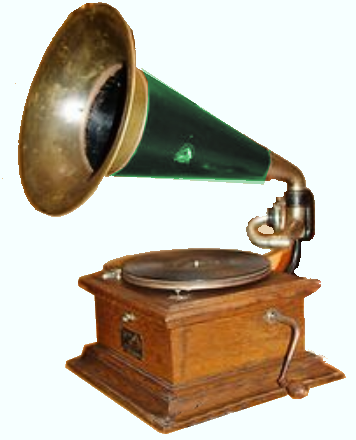
Aunt Emma, Uncle Bill, Mother and Daddy, would stay up very late playing cards. Sharon and I would pop huge bowls of popcorn which were always devoured. There was an old Victrola record player and a large stack of big black records. You had to crank the handle on the side of the big wooden box to make the turntable carry the record around and around.
Sharon and I would sing and dance the night away to such songs as Chattanooga Choo Choo, Boogie Woogie, Singing in the Rain, Missouri Waltz, Raindrops Keep Falling On My Head, Bye Bye Blues, Tiptoe Through the Tulips, Row Row Rolling Along, Just a Little Closer, Anchors Away, Happy Days Are Here Again, and others.
The boys would dance together, mocking Sharon and me, being silly as usual. They did enjoy the music though. They were usually the ones going through the stack of 78s, picking the next song. It was always a sad time when we had to go home, but there was always next summer’s visit to look forward to.
We lived on Ledford Street for 4 years, and I have so many fond memories! When I was a child, ages 5 – 9, time had no real meaning. My world was small, and everything was good. It was not until I was much older that I realized our family was poor. I’m sure there were lots of things we had to do without, but I didn’t know it. I was very happy Daddy didn’t like to go visit people much. Our family mostly stayed home. He always said, “If they want to see me, they know where I live.”
Professional Wrestling Matches

I remember that he loved to go to wrestling matches at the Admiral Coontz Armory. Mother rarely went, but Daddy would take Bob, Jim and me. My brothers would run off to play with the other boys, but Mother made Daddy promise to keep me right by his side.
There weren’t many girls or women at the matches but I loved to go. The popcorn, soda, candy, and hot dogs, were the best!
The wrestlers were very funny looking. The one I recall most was Gorgeous George. He had big muscles, long blonde hair, and wore wild costumes in bright colors with sparkles or animal prints, such as leopard spots.
The other wrestlers loved to pull his hair, and Daddy would get really excited and yell for Gorgeous George to get a sleeper hold! There were also women wrestlers, and Daddy loved to watch these matches. The women would actually take hold of the other’s hair and throw them across the ring. All of the men loved to watch them and hear them holler and scream at each other.
Life at Home
Mother made bread several times each week, did the laundry, and cleaned the house. She never went anywhere without her family. There was always something to be done. She made loaves of bread, dinner rolls and cinnamon rolls with a yeast starter that was passed down to her from great-grandmother Emma Tate.

There were no automatic washers and dryers. She had a wringer washer which had an agitator that swished the clothes back and forth. She would start the laundry with very hot water and Tide detergent. She washed the white clothes first, then the lighter colors in the same water, then the darker colored clothes. Last were Daddy’s overalls and other work clothes.
Once the last load had been washed, she would turn the wringer on, and put each piece through the two round wooden rollers, letting them squeeze the water out and back into the washing machine. The soapy water ran back into the washer and the clothes would come out the back and fall into a large galvanized wash tub filled with clean, very hot, rinse water which Mother heated on the kitchen stove.
We were never allowed to be around when the wringer was on. Mother said it was very dangerous, and could flatten our fingers just like it did the clothes she fed through it.

After rinsing the clothes, by dunking each piece up and down in the clean hot water until all the soap was removed, she would then put them through the wringer again to squeeze most of the water out. When all were done, the clothes were placed in a basket and taken outside to hang on the clothesline until dry.
We had two, long, clothes lines in the backyard, where Mother hung everything out to dry. She would shake each article several times to remove the wrinkles, and then attached each to the line with wooden clothes pins, so they wouldn’t fall to the ground. For heavy clothes, like bib overalls, she would use the spring operated clothes pin, but for most things the regular type worked fine. She always hoped for a sunny and breezy day for washday.
When it rained on washday it threw the schedule off for the whole week. We all knew that on washdays there would be bean soup and fried homemade bread for supper. Yum!

There was no wash and wear clothing back then. Everything was mostly cotton or denim and had to be ironed to get the wrinkles out. There was no dryer to fluff the clothes, and, no steam irons. So, everything had to be sprinkled with water to prepare for ironing. I got to help with this. We used a glass Pepsi Cola bottle with a sprinkling head inserted into the top of the bottle.
The sprinkling head was a rubber stopper with a round metal cap, with small holes in it. We filled the bottle with water, and then sprinkled the item until it was covered with dots of water. Then we rolled the article of clothing, and placed it in a cloth bag. After everything was sprinkled, rolled up and placed in the bag, it was put in the refrigerator overnight, which made the clothes easier to iron and helped avoid burning the fabric with the hot iron.

My brother Bob always wore black pants and starched white shirts. Mother would starch the shirts . . . no, not with spray starch. She mixed a powder with cold water and then cooked it on the stove until it was bubbly and clear. She then poured the starch into a sink filled with cold water and stirred it together. The starch smelled really good . . . so fresh and clean!
His shirts, and a few other things like my school dresses, got swished around in the solution, and then Mother would twist the shirt with her hands to remove the excess moisture before hanging them up to dry on the clothesline. Mother let me help with the ironing. At first I only ironed the pillowcases and handkerchiefs. I don’t remember ever having facial tissues around until after I was married. Daddy always carried a big red bandana handkerchief and Mother kept a pretty flowered one in her purse.

I also ironed the dish towels and such, and became quite good at ironing shirts. Mother would always brag about how nice I could make them look; even better than her! When I got older, she admitted she’d rather iron anything other than shirts!
As I got older, and taller, I could reach the clothesline and would help hang the laundry up to dry. Weekly washing took the entire day, which explains why we always had bean soup on wash day; mom didn’t have time for cooking anything complicated. Ironing took up most of Mother’s time the next day. I guess doing laundry nowadays really isn’t as much of a task as we sometimes think it is.

Roy and Pauline doing laundry at Homeplace with a gasoline engine powered wringer washer, 1974. Notice the size #2 washtub used to catch the clothes after wringing.
Every spring there was an albino Robin that nested in Uncle Charlie Tates’ backyard on Munger Street. We always watched for it, and were quite excited when it returned. It was snowy white and had blue eyes. It would sit and chirp at us across the fence. I have never seen another bird like it. It was one of God’s special creations.
Thanksgiving Gatherings
Thanksgiving day was always a special day for me. Each year we would spend the day with Mom’s brothers and their families. Uncle Jimmy and Aunt Betty Leffert, Uncle Charlie and Aunt Betty Leffert, and Mother and Daddy took turns in hosting the event at their homes.
The host family would cook the main entree, and the other families would bring sides, salads and desserts. There was always lots of food, but the best part was the fun and games.
Uncle Charlie loved to tell stories and jokes, and usually had everyone laughing. He and Uncle Jimmy would bring their guitars and play for us, and we would all sing along. We would all get together other times each year, but Thanksgiving was always the best.

In the 1957 Thanksgiving photo, taken at Uncle Jimmy‘s house, are, at the table, Left to Right, Carl, Larry, cousin Carolyn, Kathy and Leona, Gayle, and Wesley. Back row: Uncle Jimmy, Bob, Dad, Jim, Aunt Betty Renner Leffert, Dennis, Mom, Aunt Betty Majors Leffert.

This Thanksgiving photo is at our house at 905 Ely. At the table, left to right, were Gayle, Carolyn, Kathy and Wesley. Behind them are Larry, Carl, and Aunt Betty R. In the back are Bob, Leona, Jim, Aunt Betty M, Uncle Jimmy, Mother holding Dennis, and Daddy.

Thanksgiving 1960, again at 905 Ely Street. At the table, left to right, Wesley, Gayle, Carolyn, Carl, Kathy and Dennis. In back, Leona, Larry, Betty M, Betty R, Barbara Taliaferro, Bob, Mom, Uncle Jimmy, and Dad.

Thanksgiving 1961 at Uncle Charlie and Aunt Betty’s house on Park Avenue. Left to right in front: Dennis and Kathy. Behind them, Wesley, Gayle, Carolyn, Larry; next row, Carl and Barbara Taliaferro; Back; Uncle Jimmy, unknown, Jim, Aunt Betty R, Leona, Aunt Betty M, Mother, and Dad.
Christmas
Every Christmas we would take a roadtrip to the Homeplace to search for the perfect cedar tree to cut down and take home. This we decorated with colored lights and some candles that actually bubbled when they got warm.
Mother had a few very fragile glass ornaments, but mostly the tree was covered with decoration we kids had made at school. Paper rope garland cut from colored construction paper, and glued with paste, and lots of silver strands of tinsel. The silvery tensile star topped our beautiful tree.

Each of us would receive one toy for Christmas, plus socks and underwear, and sometimes pajamas or clothes for school. I usually got a doll. One year I got a doll house and a high chair for my dolls. When I was in the 4th grade I got a bride doll. That is the only doll I still have. Most of my toys I actually still had when my sister was old enough to give them to her several years later.
I also still have my Cinderella watch I received when I was in the second grade. It was a prized possession, and I guess it still is, since I have kept it so many years. It’s amazing to think, but today, at this writing, that was over 50 years ago! The only other small thing I have managed to keep is a miniature lamp from my doll house. I would sit for hours and play with the house and all its miniature furnishings, rearranging the pieces in hundreds of different settings.
Paper Dolls

Another of my favorite pastimes was playing with paper dolls. Paper dolls are figures cut out of paper or thin card, with separate clothes, also made of paper, that are usually held onto the dolls by paper folding tabs. Paper dolls have been inexpensive children’s toys for almost two hundred years. I kept mine in an old shoe box, and was always very careful to put the many pieces of paper clothing away so they would not wrinkle, or, accidentally tearing off one of the tabs that hold the clothing in place. Many hours had been spent carefully cutting each small garment
I remember Mrs. Mitchell, my first grade teacher, was very impressed at how well I could cut things out. She would let me help her decorate the wall board in our classroom. That was how we would spend a lot of our special lunch hours together.
913 Ely Street
It was in the spring of 1955 that the life I had grown to love was to end, when Mother and Daddy told me we were going to move! I was shocked! I could not imagine life anywhere else could ever be as wonderful. I would have to go to a new school where everyone would be a stranger! How would I ever survive without my friends and the family members that I had become so used to being around everyday?

I was devastated! I cried, and Mother told me that everything would be okay. She said that we would have family close by, and that I would make lots of new friends. When I asked, “But why do we have to move!? She hugged me, and said, “We will really need more room.” “But, why?” I managed to say between my sobs.
“I have a surprise,” she said, and I learned that I was to have yet another brother or sister. Of course, I was very happy then, but can also remember thinking, “How many more brothers am I going to have?” No one else I knew had four brothers, like me, and soon I might have five!
I was 10, and in the 4th grade. It was my last year at Eugene Field School. They were special years. I remember how sad I was the last day of school, knowing I would never return to attend classes at this place that had been such a large part of my life. How would our new school, Stowell, ever take its place!?

We moved in March of 1955 to the house at 913 Ely Street, Hannibal, at the top of what seemed to be a really big hill. My Uncle Charlie and Aunt Betty Leffert lived just one house away at 905 Ely, which we would later live in.
913 Ely was a four room house, and it was, indeed, much bigger than our home on Ledford. Uncle Charlie, Daddy, Mother, my brothers, and I, spent days peeling wallpaper from the walls. Uncle Charlie papered each room with fresh new wallpaper, after painting the old wood work. Mother washed the windows inside and out until they sparkled in the sunlight.
The curtains at the kitchen windows, and on the back door, were white, with ruffles all around, and trimmed in red. The wallpaper was white, with dishes and pots and pans trimmed in red. I don’t really remember the wallpaper we put in the other rooms, but do remember how happy Daddy was that he no longer had to look at those big roses!
The floors were covered with shiny new linoleum. New curtains were hung, some of which were made with a new thing called plastic. I’m not sure if that was the fashion at the time, or just economical. Whichever it was, it was beautiful to me!

The thing I remember most, was the shiny smooth tabletop, which was also marbled red and grey. I had never felt anything so slick and smooth!
The kitchen/dining room was so much bigger than the one we had before! Sears delivered a brand new white refrigerator and a white kitchen range. There was also a bright shiny new kitchen table and chairs! The 8 chairs all matched, and were covered with gray and red plastic. Each chair had chrome studs all around the back and the seats. The chair and table legs were shiny chrome.
Several family members gave us furniture. We actually had a living room with no beds in it! There was a big soft sofa and chair, and even end tables with lamps, and a beautiful floor lamp that made the room feel very cozy.

We no longer had a big black coal stove sitting in the corner! The living room had a gas heating stove with panes of asbestos through which you could see the blue and orange flames. The bedrooms and kitchen had smaller versions of gas stoves.
The boys were very happy that they would no longer have to clean the ashes from the stove or keep the coal bucket full. Of course, Mother was happy she would not have to clean up the mess from the ashes and the boys tracking through the house with the coal bucket. I was happy that I could lay on the couch, be warm, and watch the flckering fire.
Riding Bicycles to School
Bob, Jim, Larry and I, didn’t go to our the new school until the fall of that year. We were allowed to ride our bikes to Eugene Field to finish the current year, which made us very happy. I don’t remember how long it took to get there, but Ely Street was about 10 blocks from our old Ledford address, so to Field school was a total of 15 blocks. The spring weather was very cooperative that year, and most days the ride was enjoyable.
Katherine Ellen Arrives

Only six weeks after we had moved to Ely Street, Mother went to Levering hospital to give birth. On May 19th, 1955, my sister Katherine Ellen was born. I was so thrilled that I finally had a sister!
When Mother arrived home with Kathy, I could hardly wait to unwrap the blankets to see her! She had dark skin, dark eyes, and dark hair. She looked very different than my brothers, Larry and Carl, did when they were first born. Kathy was very tiny, and had long skinny arms and legs. Mother said she got her dark complexion and hair from Daddy.
I immediately started helping take care of her. I distinctly remember her first bath. Mother had made a pan of warm bath water, which she then carried into the living room next to the stove. She said little babies love to be warm, and would always like to be bathed if they were kept warm.
I ran to get a towel, which Mother put on her lap. She undressed Kathy and lay her across the towel. I stood right next to her, and when she removed Kathy’s diaper, she pooped, and it squirted all over me and the floor! Mother laughed, and told me perhaps I should stand in front of her. After that, I knew you had to be careful when the baby was without a diaper!

That summer, and the summer that followed, on Ely Street, were full of new adventures. Aunt Emma and Uncle Bill Jennette had moved to Hannibal from the farm in Frankfort, and lived just two blocks from us. We could actually see their house from our front porch, because the street curved at the bottom of the hill.
Taliaferro Grocery Store
Up the street from us was the Taliaferro grocery store. It was very similar to Hamilton’s store. It soon became the place to gather, just as we had done on Ledford Street. Mother always had an account at the store, and we were each allowed to charge $0.50 a week on candy, ice cream, and soda. We thought this was a pretty good deal! This served as our allowance for helping with the chores around the house.
Jim and Bob cut the grass, took out the trash, and swept the porches and sidewalk. I set the table, did the dishes, and entertained the little ones while Mom cooked and cleaned. There were always toys and games to pick up, clothes to fold or hang up, and after dinner each night, the kitchen had to be swept and the table cleared and wiped down.
It didn’t take long to meet all of the kids in the neighborhood. There was a ball field right next to the Taliaferro store, and we would gather for a baseball game almost everyday. It seemed there were always more boys than girls. We managed to keep up, even when they played their roughest.
Barbara Taliaferro
Barbara Taliaferro lived across the street from the grocery store that was run by her Uncle Henry and Aunt Helen Taliaferro. They were brother and sister, and grandma Taliaferro lived with them. The store was attached to the front of their house, which was a common design for neighborhood groceries.
Barb and I became very good friends. Her parents were Red and Beulah. Red was brother to Helen and Henry, and there were two other brothers who lived in the same block. They were a very close-knit family. Barb was two years older than me. Her Mom would often let us bake cookies and treats for everyone at the ball field. I remember making popcorn balls. What a mess we made!
Barb later dated my brother Bob, and she would go with us on most of our family outings. Uncle Charlie and Aunt Betty Leffert would take us to the Homeplace a lot. Barb and Bob later married.
Limestone and Campfires
Ely Street was surrounded by limestone hills and bluffs. There was a big hill behind our house that had lots of trees. My brother Jim made a path through the woods to the top of the hill where we found limestone cliffs and a big open area. This became one of our favorite places to hike to.
We would build a fire on the flat rocks at the bottom of the cliff, and cook hot dogs and marshmallows. Sometimes we would pack a skillet, potatoes, and a jar of Mother’s homemade chili sauce. We would fry the potatoes over the open fire and cover them with the sauce. Mom made the best chili sauce! We had old tin plates and cups to eat and drink from. I recall thinking as we ate those delicious potatoes, while sitting on the big boulders, that Ely Street was really okay. Life was good!
At the top of the hill, on the opposite side of the street, was Park Avenue. This is the route we took to school. There was a path through the woods that came out on Park Avenue. From there we walked down a very steep hill to Terrace Street, then to Union Street, through the playground, across Fulton Avenue, to Stowell School. By the time school started that first year, we were accustomed to our new surroundings, and were actually excited about attending the new school.

Although there was no one in our neighborhood that would be in the 5th grade, like me, I had decided that making new friends was not nearly as hard as I had thought, and it might even be fun.
Mrs. Shipley was my teacher that year, and she was very nice, however, very strict. I was amazed at how everyone wanted to meet the new girl, and after a few days it was like I had always been there! It was a good lesson for me. One that helped me throughout my life, making friends, and adapting to new locations. This came easy after that experience.
Academically, however, fifth grade proved to be my most difficult year of school. I was very sick, and missed over 100 days of school. I had hepatitis, twice, and lots of bad throat and ear infections. Four times I had to go to the hospital and stay several days. I just couldn’t get my strength back before I came down with something else.
My brothers would bring my assignments home, and I worked really hard to keep them done, but sometimes it would be days before I felt well enough to work on them. Not being in class, and not being able to make up tests, really hurt my grades. Mrs. Shipley was very understanding, and would tell me that I would do better next year.
She said I couldn’t help it if I was sick. I was really skinny, and the doctor put me on a weight gaining diet. Everyday I had to eat two peanut butter and banana sandwiches. Because of the hepatitis, he did not want me to eat any fried foods, chocolate, or nuts. I remember that Mom made me lots of strawberry milkshakes during that time.

My classmates couldn’t understand why I missed so much school, and often asked me if I had really been sick. Most of them had never been in the hospital, and we were very curious about my stays. The two things I remember most were the number of shots that I had, and how much I missed my family.
Children, back then, were not allowed to visit patients, so I didn’t get to see my brothers or sisters for long periods of time. During one of my hospital stays, I counted 115 shots they gave me. My butt was really bruised when I got home!
Mealtime At Home
My Mom’s meals were never fancy but she was a very good cook. We ate lots of potatoes; there were fried potatoes, mashed potatoes, buttered boiled potatoes, creamed potatoes, and potato salad. There was also lots of gravy, too. My favorite was white cream gravy, but Mom’s dried beef gravy was really good, too! She never made gravy with sausage in it, but, she did sometimes make gravy with hamburger. It had no milk . . . only water, flour, and hamburger. I really didn’t like it, but, if that is what you were given, that’s what you had to eat!
She always made a large pot of beans every week on wash day. There were pinto beans, butter beans, my favorite, Great Northern beans, or navy beans. Mother’s bread and dinner rolls were the greatest! Made from a 100-year-old yeast starter passed down in the family for generations.
That bread, hot out of the oven with real butter, was so delicious, the yeast starter was split and portions given to the Vaughn family. Mother sometimes made cornbread. Daddy liked to eat leftover cornbread in a bowl with buttermilk poured over it. I never could figure that one out!
The only spicy foods I remember her cooking was chili or hot tamales. She used a frozen chili brick which she purchased in the refrigerated section of the store to make chili soup. Her tamales were the best, and took an entire day to make.
She boiled beef and pork roast together in the morning. When they were done, she would grind them together with saltine crackers in an old hand-operated metal meat grinder that screwed to the end of the kitchen table. It was a lot of work!

Once the grinding was done, she added chopped onions spices and tomato juice. Then she cooked cornmeal in the broth from the roast to make mush. After that was done, we all pitched in to help roll the tamales. She used white tamale papers. We would put a tablespoonful of the mush In the center of the paper, leveling and spreading it out with the back of the spoon. In the center of the mush, we placed a spoonful of the meat mixture.
Bringing the opposite edges of the paper together, you folded them together a couple of folds, squeezing the contents into a long hot tamale. The ends of the paper were folded into a point and then tucked to the back. When we had emptied the pots we usually had about a hundred twenty tamales. These were everyone’s favorite, and we always had fun sitting around the table rolling tamales and sharing stories.
Tamales

If our friends or family knew we had made tamales, they would always drop by to have a couple. Mom’s tamales were everyone’s favorite. She usually had navy bean & bacon soup with them. Yum!
After we finished the tamales we would always compare them to see who had wrapped the most, who made the longest, fattest, shortest, or who had the neatest wrappings. Of course, Mother always wrapped more than anyone. Daddy wrapped the least, and his varied the most in size. He always said his fingers were too big. Bob seemed to make the neatest, Jim the biggest, and mine were the smallest of the bunch.

When we had meat, it was usually purchased at Buehler’s Meat Market on Main Street. It seems we ate more pork than beef, perhaps it was less expensive. It was often pork steak cutlets and roasts. We had noodles, dumplings, and macaroni a lot. Dressing, stuffing, and bread pudding were made with any stale bread we had. Salt and pepper was about the only seasoning mother used.
Eggs, pancakes, and oatmeal were served for breakfast. My favorite cereal was Puffed Rice, which Mom bought in big clear plastic bags. My brothers liked corn flakes. Our lunches were usually sliced bologna, fried egg, or peanut butter and jelly sandwiches on mother’s homemade bread.
Mother made very few desserts. My favorite was her graham cracker pie. The graham cracker crust was baked crisp, filled with homemade vanilla pudding, and topped with meringue sprinkled with graham cracker crumbs. Her attempts at making cakes for birthdays were usually not very successful. They almost always turned out too flat and too dry. But, the birthdays were always special, no matter how good the cake was.
We never ate at restaurants, of course. I’m sure my parents could barely keep enough food on the table at home, so eating out as a family was just something we never did because of the cost. Back then there were no McDonald’s or Burger Kings, Wendy’s or Hardee’s.
The Badger Chaser

Daddy bought an old 1929 Ford Model A truck from the junkyard, which we kept at the Homeplace. It had been used as a wrecker in its final years, with a winch and associated accessories. The tow equipment had been removed and the frame had been cut off right behind the rear wheels, rendering it useless as a work truck. There was none of the original metal body work or flooring behind the dash. There was no seat, top or fenders.
My brothers loved to drive that old thing! They would sit on a bucket or milk can, because there was no seat. They boxed in the area over the rear wheels to make a cargo space, and threaded a piece of chain around the worn-slick rear tires to get some traction on the hills.
They would put the big metal milk can in the back, and go over the hill to the spring to get water. Uncle Charlie later made a trailer to pull behind the truck. We would all pile into the trailer, and he would drive us all over the countryside. What fun!
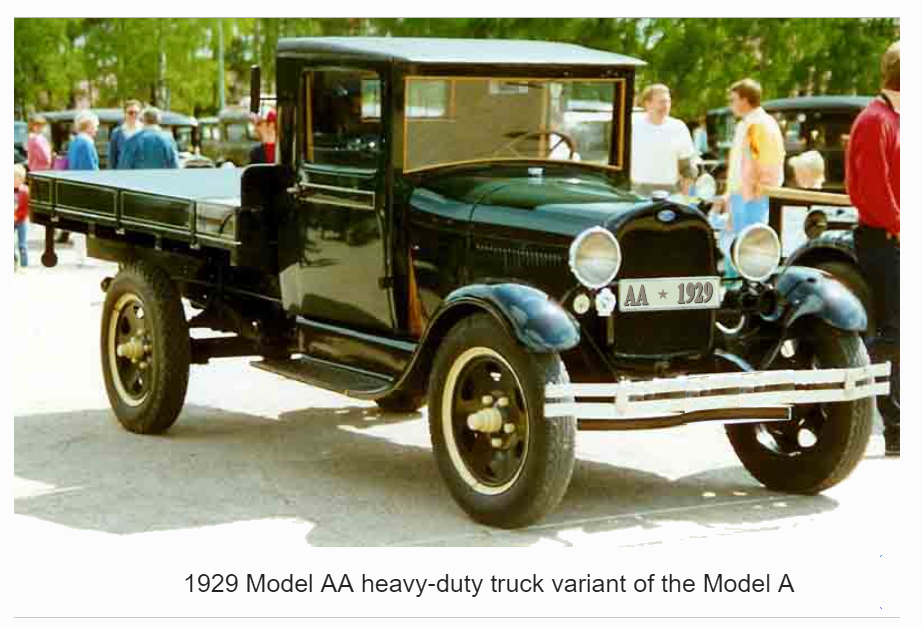
Daddy let me drive it once. I managed to get it into first gear after several attempts, and drove straight for a tree! Daddy kept saying brake! Brake! Brake! He finally reached over and turned the ignition key off, killing the motor, and we stopped about six inches from the tree!
He had forgotten to tell me to use the clutch when braking, but, the biggest problem was my legs were neither strong enough, or long enough, to push the brake pedal down far enough to stop.
We painted the truck red, blue and yellow, and wrote funny sayings all over it. The guys were always tinkering with the motor to keep it running. At one point, we named the truck “Badger Chaser,” and repainted it whenever we took a notion.

Dennis, driving, with Dawn and Scott Tate, with neighbors, 1977
Bob The Family Driver
Bob was sixteen now and had saved his money he earned mowing lawns to buy a car. His first car was a brown 1941 Hudson Hornet. His second car, as I recall, was a 1949 grey Pontiac. The Hudson was a big car, and the seats were soft and deep.
Everyone would fit in comfortably, and Bob would drive us into town, sometimes to school, often times to the Homeplace, and surrounding small-town festivals where Uncle Charlie and Uncle Jimmy would be performing. The Pontiac he bought when he was in high school.

My favorite though, was his 1954 Hudson Hornet. It was bright yellow, had lots of chrome, and wide white sidewall tires. I remember he put curb feelers on the front fenders to avoid scraping the whitewalls on the tall sidewalk in front of our house.
They were just wires that extended about 12 inches from the car, but they would make noise when they hit the curb, scraping along as he was parking. Curbs along Ely Street were about 8 inches high, probably to help carry away the heavy rainwater that flowed down the steep hill.
Bob loved that car, and was always washing and waxing it. It would shine like the sun he had every gadget available on it: I recall mud flaps, running boards, visor, steering wheel knobs, fender skirts, doodads on, and hanging from, the rearview mirror, and turn signals, in addition to the curb feelers.

He also had a Model A pickup truck, much smaller than the Model A we had at the Homeplace. He used to drive it all over. We would all pile in the back, and have fun going wherever he was going, just to take a ride and get away from the ordinary.
Having a car and the driver in the family changed our lives tremendously, of course. Bob loved to drive his beautiful automobile and was always looking for excuses to take it for a spin.
Going to the A&P grocery store on Broadway was almost a daily event. I can still recall the smell of the fabric of the seats! They were dark gray mohair, I believe. The car was so big the whole family, now 6 children, and Mom and Dad could easily fit into the two seats! There were no seat belts in cars those days, so everyone could crowd in, sitting on someone’s lap if they needed to, or even sit in the floorboard!
Sunset Valley Troubadours

We often went on trips with Uncle Charlie and Uncle Jimmy and their families. We would go to small-town festivals, Steam Thresher shows, and county fairs. My favorite trips were when we would all go to country school socials, where Uncle Charlie and Uncle Jimmy would perform with their country and western band, The Sunset Valley Troubadours. Each family in the community would bring covered dishes, and there would be tables full of delicious food. Those country folks sure do know how to cook!
Everyone would eat and while the ladies were cleaning the tables and rounding up the kids from the schoolyard the band would tune their instruments and warm up for the show. And, what a show it was! The members of the band dressed in Western attire. Their shirts were beautiful, with embroidered flowers and fringe. My favorite shirt was a black one, with bright red roses, white fringe, and pearl buttons.
They sang the songs of Ernest Tubb, Jim Reeves, Minnie Pearl, and many other country stars of the day. They told corny jokes that always made everyone laugh, sometimes just because they were so silly. They also did songs they invited the crowd to join in. All in all, it was a great time for everyone. Everyone was so nice! We would stand around the school yard, visiting, long after the music had stopped.
The St. Louis Zoo

A few times, we packed a picnic lunch and drove to Saint Louis to go to the zoo. Admission was free, so it was a perfect place to take all of us. Gayle and Carl were toddlers, and Cathy a baby, so there were three strollers to push. I liked watching the monkeys the most. Uncle Charlie would always get them riled up by mocking them and making silly noises. I was also fascinated by the giraffes. How do they keep those long necks upright?
I remember one time at the zoo when we paused to have our lunch, Daddy said he really wasn’t hungry, but sure could use a cup of coffee. And, of course, Uncle Charlie had brought a big thermos filled with hot coffee. He rarely went anywhere without his coffee.
He poured Daddy a cup, and Daddy walked over to the shade of a big tree to enjoy his favorite drink. But, before he even got his first sip, a bird pooped right into his cup! I thought Uncle Charlie was going to die laughing! He doubled over in pain, his stomach hurt so much from laughing, and tears ran down his cheeks! The rest of the day, he kept asking Daddy if he wanted some more cream in his coffee.
The Newspaper Route
The summer of 1956 I had my first job. Barb Taliaferro and I delivered the Hannibal Courier-Post newspaper. We shared the delivery route of about 15 houses up and down Ely Street after school. This part of the job was actually fun. However, on Saturday mornings, we had to collect that weeks subscription money.
We knocked on doors for half of the day. It seemed, sometimes, waking grumpy people who just wanted to sleep a little longer, waiting in the cold while the old ladies gathered up their coins, and then make polite conversation while they stood in the warm doorway. And, we were freezing our butts off!
We also had to shove off the bad dogs and play with the cute ones. A lot of the time we found no one at home and had to return, sometimes several times, before we could collect. But, the experience was very worthwhile, and Barb and I benefited not only financially, but spiritually as well.
There were many times that we helped individuals along our route. Whether it was moving a flower pot, running to the store to get a loaf of bread, sweep the porch, rake the yard, take the trash out, or deliver a message to a neighbor, each person we got to know helped us to understand more and more about the responsibilities you inherit as you grow older. Of course, a lot of these tasks I had already adopted, because in a large family, everyone has responsibilities, and sometimes, I had to do someone else’s share.
When possible, I would go to school functions, church parties, or to a friend’s house. However, this was not often, because Daddy simply liked for us to be at home. And, that wasn’t bad . . . we had a lot of fun as a family.
My Taffy Pull
When I was in junior high school, I took a class called Domestic Arts, which taught girls how to be homemakers. A part of the class was cooking. Mother often let me experiment in the kitchen, and would even clean up my messes. I remember one night I decided I wanted to make vanilla taffy like I had just learned at school. Taffy is basically corn syrup, sugar and water heated together to a certain temperature. Mother showed me how to test a bit in a bowl of ice water until the candy was just the right consistency.
When I got it finished, and it had cooled enough to be handled, Daddy and I pulled and pulled on that big blob of taffy, stretching and folding it over and over again. We had to keep putting butter on our hands so they wouldn’t stick to the candy. Just as we were about to give up, thinking the blob would never be more than a blob, it began to get those necessary little air bubbles in it, and they would pop as the taffy was folded and twisted. Daddy and I kept stretching it out and it began to stretch into the snow white strands of candy. When the strands were stretched out, and begin to sag, I would take my end back to Daddy, folding it in with the rest. Then I would pull another strand out and repeat the process.
We did this for more than an hour, when finally Daddy said that it was just not right. We put powdered sugar on the table and rolled the taffy into a long snake about an inch in diameter and 4 feet long. Daddy begin cutting inch long pieces, rolling them in the sugar, and placing them on wax paper. Mother had cut squares of wax paper to wrap each piece. The taffy was delicious, however, no one ever chose to repeat the process and make more. If Daddy wanted taffy, Mother said she would go to the Sweet Shop and buy it!
Aggravating Daddy

One of the things we loved to do to aggravate Daddy, was to be really quiet so he wouldn’t know we were in the house, and call him on the phone from the living room. We could do this because at that time there was no touch tone or even rotary dial telephones.
You picked up the phone handset and a live operator would say, “What number please?” We would give her our own telephone number, 5270, then as soon as she would say, “Thank you,” we would hang up.
She would not get a busy signal because she already had the line open. Then, she would ring our phones; one in the living room, and one in the kitchen. Daddy hated to answer the telephone, because he might be called back to work, and as soon as it would ring he would yell for someone to answer it. Daddy was almost always sitting at the table in the kitchen and after yelling 2 or 3 times, and not knowing we were in the house, he would finally get up and go around the kitchen table to answer the telephone.

When he said, “Hello,” we would ask silly things such as, “Is your refrigerator running?” He would say, “Yes,” and we would say, “Well you’d better catch it before it gets away!” Or, we’d ask, “Do you have Prince Albert in the can?” That was a brand of smoking tobacco for his pipe. It was packaged in a pocket-size tin can, and, was usually found in Daddy’s bib overalls pocket. When Daddy said, “Yes,” we would say, “Well, let him out!” Then we’d hang up the phone, and run.
By the way, “can” was a slang term for jail in those days. Being “in the can” meant being in jail. Of course, every time we did this prank, Daddy would slam down the phone, hurry towards the living room, and start yelling, “I’m going to get you kids! You’d better get outside and play!” All the time we were giggling, running out the front door, and long gone before he could get to the living room in the front of the house.
On weekends when the phone would ring, Daddy would always say, “I’m not home!” This we knew that if it’s the railroad calling, it meant, “I’m not going to work.” I would not usually answer the phone when he said this,because I didn’t like to lie. Of course, nine out of ten times he would then yell out, “Okay, I’m here, and I’ll go to work if they need me.”
Babysitting
I babysat for a lot of the neighborhood kids on weekends during the school year, and during the summer months, I would babysit all week. During the day, often times, the whole summer for one family when both parents worked days. Mother was always close by should I need anything or have questions. Most of the money I made, I spent on clothes, or shoes, for school. But, occasionally, I bought a piece of jewelry, nail polish, or candy.
Sixth Grade

My sixth year of school was better, because I did not get sick so much. We had lots of fun school activities. I was in the Glee Club, and we sang at several performances. The school had sock hops where they played records of current hits, and everyone came wearing socks creatively decorated. Jim played football and basketball, so we attended a lot of games. Our lunch hours were spent at a small grocery store across the street from Stowell School. Everyone gathered for much fun and joking around.
The most popular hairstyle that year was long and flipped up at the end.
I wore mostly very full skirts with can-can slips and white tailored blouses. We wore penny loafer shoes, ballerina flats, or saddle oxfords, which were brown and white with white shoe strings.
Keds sneakers came out about that time, and they were not very expensive, so I had several different colors. We liked them because we could still wear our bobby socks and change the shoelaces to make colors match our outfit
My best friend at school was Wilma Michaels. She lived up the hill behind the school. We spent hours looking for four leaf clovers and talking about everything. This was the first year I became interested in boys. Vernon Sheets was really fun to be with, and I would always try to find out if he was going to a party or game before I said I would go.
Ruby & Pete Kindle
Our cousins, Ruby and Pete Kindle, who lived in Moline, Illinois, came to visit us a lot on weekends. We played cards and games day in and day out. Pete would often cook fried fish or chicken, with all the fixin’s. It was amazing the fun and joy we shared! The weekends were always too short!

Of course, we continued our trips to the Homeplace. Daddy loved to be there, and we kids would always have fun. Uncle Charlie and Aunt Betty Leffert would go with us, and Uncle Charlie almost always had a Homeplace project going that we had to help with.
We spent many happy and memorable hours hiking through the woods, collecting holey stones in the brook, swimming in the Fabius River, bringing water up from the spring, cooking huge meals on the outside fire pit, playing cards and games of all types, telling jokes and stories around the fire at night, and seeing who could stay awake the longest so as not to miss any of the never ending fun.
Saving Cousin Mary
My cousin, Mary Ellen Constable, tells about one time I “saved her life.” My brothers, cousins, and I were all swimming in the river, and Mary Ellen, being the smallest, got caught in the swift current and was being carried away. She panicked, and said she just knew she was going to drown. The current brought her right toward me, so I reached out and pulled her to calmer water.
It seems that I have been a hero in her eyes since that day. When I saw her, after many years, at her Dad, Everett Constable’s, 90th birthday party, she was telling friends that she wouldn’t have been there had I not saved her from the raging river that day so many years before!

Below: Back L-R:Joseph Frederick Tate, Charles W Leffert, Roy Davis Tate Front: Lulu Belle and Dorothy Tate with Robert Leroy Tate – 1943 F

1951

1951 – Above L-R: Katherine Ellen, Leona Marie, Robert Leroy with Larry Davis, James Wesley
1955


1961-Leona, Carl, Kathy, Pauline with Dennis, and Larry
 Tate Family of Fabius Township