

Roy Davis Tate, born April 24, 1911, was the youngest of ten children born to Joseph Frederick Tate and Amanda Elizabeth Leffert. Roy was born on the three acre Tate homestead, which he called “the Homeplace,” and his descendants now call “the camp.” Three of Roy’s infant siblings had passed before his birth, and are probably buried on the knoll in the yard near the cabin with other infant family members.
Roy was the youngest child in his family, with Charles being eight years older, and Earl being ten years his senior. His oldest sister, Rosa Lee, was fifteen, and Margaret Ellen “Maggie,” thirteen years older. Amanda “Lizzie” was six, and Emma was his senior by three years.

By the time Roy arrived, the family was a well functioning team, with brothers and sisters old enough to make significant contributions to daily life, and reduce the workload for everyone. There was now enough egg money that he and Emma got to attend the Oak View subscription school in their area. The oldest brothers would have been making their own way in the world, and the older girls were starting their own families.
Generation 17
1910 Census Data
The 1910 Federal census shows that Roy’s parents, “Fred. J. Tate,” age 36, and Amanda, age 32, married 16 years at that time, resided in Fabius Township, along with daughters Rosa, age 15, Margaret (whom they listed as Maggie), age 12, Amanda (whom they listed as Lizzy), age 4, and Emma, age 1, and brothers, Earl W., age 8, and Charlie, age 6. Which house they lived in is not noted, but it is known that they had at least three residences in Fabius Township over the years.
In addition to the Homeplace cabin, the family at some time had another small house a quarter mile further down the gravel road from the current Homeplace entrance, at the end of the road. Today the property beyond the end of the road is the Lovelace farm.
There was also a 2-room log cabin with a loft believed to be on a piece of property purchased by Fred Tate a short distance away to the north, likely used during the years he worked on the Guardhouse farm. There is a photo of Fred’s wife, Amanda, feeding chickens in the yard of the log cabin.
There was another house located on the county road at the entrance to the Elizabeth Harsell farm. It was in this house that John Leffert and his sons resided after arriving from Indiana. In 1907. It is in this house that fire broke out and destroyed all family photos and records John had brought from Indiana..
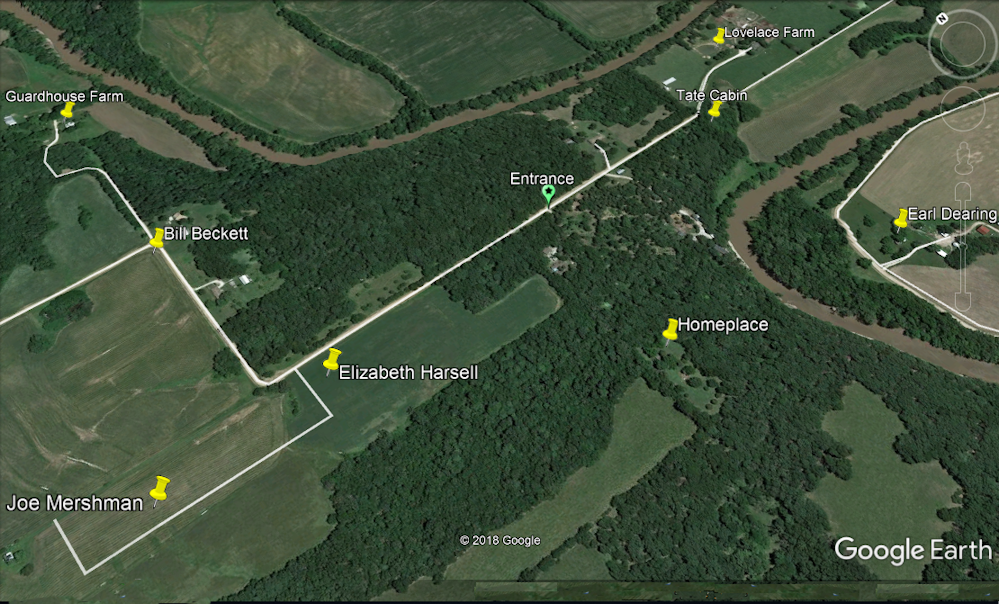
Each of these residences could be listed in the 1900 census as “Fabius Township,” because there was no mail delivery, no public school routes, no paved roads, and there were no street addresses. But, since George Tate, age 76, was residing in the home with Head of Household, Fred J Tate, and others, we presume this residence to be the Homeplace.
Residents had to travel to Palmyra and Taylor, the two closest post offices,
usually on Saturdays. to see if there was any mail for them. Travel to town often halted after a rain to give the dirt roads time to dry. There was hardly anything worse than having to get out of the buggy or wagon in your “going to town” clothes to get your ride out of the mud.
1918
In 1918, Roy’s father noted on his World War I draft registration that he was living at Route 1, Taylor, on or near Samuel Wibell’s farm. The 1934 Land Plat Map of that area shows the Wibell Farm just to the left and slightly above the property Fred Tate purchased.
According to Dennis Tate, Roy stated that he went to Oak View school when he was seven or eight until he was twelve, and didn’t go to any other school. That would be the period from 1918-1923. His father, and presumably his mother, lived on or near the Wibell Farm during those years, so then they were not living at the Homeplace in September of 1918, but Roy and Emma were, which helps validate that the family got spread out between the residences. Roy may have lived with older sisters, who were tending to chores at the Homeplace, so he could attend school.

The bottom of the above map had these handwritten notations:
- Land in the District – 5700 acres
- Assessed Valuation – Personal Property $35,000 / Real Estate $35,000
- Enumeration, School Age – White 42 / Colored 5
- County Roads in District, Miles – 14
- Of which are graveled – 2
This area was south of Hester, north of Smileyville, West of Taylor and West Quincy
1920 Census
The 1920 Federal census shows “Fred J Tate,” age 46, living in Fabius Township, with wife Amanda, age 42, Earl W, age 18, Charley, age 16, Amanda E, age 14, and Emma, age 11, and Roy, age 9. Fred, and his father, George, apparently worked on the local farms of all three neighbors, Earl Dearing, Charles Johnson, and Frank Harsell, as well as raising hogs and chickens at the homestead.
These farmer’s names were often affectionately mentioned by Pauline Tate as places Roy and Charles worked. Roy and Pauline both worked for Harold Guardhouse; he as a farmhand and her as a housekeeper.

Roy and Emma – 1923 – Oak View School (Note the handwritten “Xs”
Roy and his sister Emma attended the Oak View School nearby. The school was about a mile and a half by road, but Roy and Emma would take a shortcut through two farm fields from the Homeplace. Roy finished the fifth grade, and then quit to go to work. According to his youngest son, Dennis M Tate, Roy could barely read or write. In fact, he said, Roy would put an X on his paycheck, and then have Pauline sign it, and cash it at the neighborhood store.
Uncle Charlie Leffert handled much of the family business dealings, such as keeping track of payments made and amounts owed, to help Roy purchase materials and building supplies, and Pauline kept track of the bills, traveling to all the merchants once a month to make the payments in cash.
1930 Census
The census was taken in April of 1930, and shows Fred, age 56, Amanda E, age 52, and Roy D, age 18, living on Bay Island in Liberty Township. Neighbors included George W Palmer, farmer, and George W Otten, grain farmer. Other surnames in the Bay Island area included Wagner, Spires, Culpin, and Curtiss. It also shows that Fred was 20 when he first married, and Amanda was 17. Fred, Amanda and Roy all indicated that they could read and write. 1930 census shows Charles F, Clara, Albert and Delbert lived in Liberty Township, Marion, MO.
1933
Roy’s brothers and sisters had all moved out and started their own families by 1934. His dad, Fred, was working as a farm laborer on the adjacent Earl Dearing farm. Fred always had a couple of hogs they were raising for meat and fat. Amanda tended chickens, and knew how to use a rifle to protect them from foxes and racoons. She also maintained the household and their personal garden.
Fred, Roy, Charley, Lizzy’s husband Harry Cook, and Emma’s husband “Bill” Jennett, were working as laborers on the nearby farms that could afford to hire hands, though the work was drying up.. This was during the Great Depression, and was likely the year Fred decided to hire on with George W Palmer, who had a large farm in Liberty Township, just north of Hannibal, MO. They moved from the Homeplace, and Maggie’s husband, Tom Reddick, who was down on his luck moved his family in.
The census also shows that John W Leffert, 67, Charles W Leffert, 13, and James J Leffert, 11 were living in Fabius Township, possibly at the Homeplace, although it is known to the family that he also once had a house on the gravel road just a quarter mile from the Homeplace entrance. Remains of the burned down home could still be seen from the nearby gravel road when this author first visited the Homeplace in 1961.

The Bay Island House
Pauline related that the house they rented on the Palmer Farm was merely a pole barn entirely covered with corrugated tin roofing. There was no insulation of any kind in the house, and the walls were always as hot or cold as the outside air. Cardboard nailed up between the poles formed the interior walls.
In the winter time, snow would blow through gaps between the sheets of tin and actually pile up on the dirt floor inside the house! When those piles of snow melted, they created muddy spots in the dirt floor.
The years Fred and his family spent on Bay Island were significant for many members of the family. In 1998, Charles Wesley Leffert wrote of his recollections of the house and times on Bay Island, and other family memories. The letter is reproduced here, except I believe the last line of text was missed in the digital file given to me.
Memories of Uncle Charles Leffert


I heard Charlie tell this snipe hunting story, and he said he and Roy would make noise as though they were trying to flush one out, while making their way back to the house. They would then get some distance away, but still within earshot of the person holding the bag, and then say in a hushed voice, “Quiet! There’s one!” Then they would sneak back to the house for a cup of coffee, leaving their victim holding the bag!
Tate Homeplace

Like his father and grandfather, Roy was a farm laborer, working on area farms as work was available, as well as raising a hog or two, chickens, fruits and vegetables at home. In the winter, when there was more free time, attention was turned to hunting game to be butchered and preserved for the coming year, gathering and chopping wood for cooking and heating, and making improvements on the property.
“Egg money” helped some families survive, so taking care of chickens, and taking the eggs to the market to sell, was a very important chore. Many times the spare egg money was all families had to pay for the children’s education at the local school, or to buy those little luxuries that helped make life easier. The family farm continued to be the basic social and economic unit for many years, and life revolved around the yearly cycle of farm work.
The Outhouse

The Homeplace, still at this writing, has no electricity or running water, and no bathroom; only an outhouse, which was common practice before indoor plumbing became available. First time visitors to the Homeplace are usually fascinated by the outhouse, and how it works.
Some families had more than one outhouse. Sometimes there was one for gals and one for guys, while others had a double outhouse, sometimes with two seats in each compartment for large families. Vent holes were cut near the top to let fresh air in and stale air out. One always hoped there was a little breeze when they headed to the outhouse.
The structure was located over a deep pit in the ground, and was used until the pit was near being filled, and then the outhouse would be moved to a new location, the previous location being covered with odor-reducing lye powder, and then filled with topsoil.
The primary purpose of the building itself was not only for privacy and human comfort. It did, of course, prevent the user from being exposed when it was raining, cold, or windy. However, the building has the secondary purpose of protecting the toilet pit from large influxes of water when it is raining, which could flood the pit and flush untreated wastes onto the lawn before they could decompose.

These outdoor toilets are referred to by many terms throughout the English-speaking world. “Outhouse” is used in North America, while “Privy”, an archaic variant of “private”, is used in North America, Scotland, and northern England. In Australia and New Zealand, an outdoor toilet is known as a “dunny”.
Homeplace Photos ca 1931

It must have been family picnic and photo day at the old Tate Homeplace, circa 1931, and the ladies decided to make it a theme day. They fashioned scarves to wear with a light colored blouse and their best pair of denim jeans, if they had a pair. If not, a good pair of overalls would work, too. These photos came from Charlotte Jennett Barrickman and Delbert Tate collections.

For many years we thought the photos from Charlotte’s collection were of the CB&Q row houses in Mark Bottoms, until we were given some photos to digitize by Delbert Tate. In his collection was a photo of his family standing in front of the same house, when he was about three-and-a-half or four years old. His mother noted on the back of the photo that it was the “Tate old home place,” and on the front, noted, “Hester, MO.”

We didn’t initially think it was the building we now call the Homeplace, but research by ancestor and part owner Dennis M. Tate indicates that it probably is. Notice the homemade wood shingles on the roof.
Restoration
Dennis did a tremendous amount of work to restore and maintain the property over his lifetime, and said, “The construction technique is right, the door and window are right, and the hole in the roof is where the worst interior weather damage was when dad (Roy) and I started restoring it. You have to keep in mind that the house was empty more than it was used after dad (Roy) and his family moved out (to the Palmer farm).”
It would have been empty from 1923 until the out-of-work Reddick family moved in during the 1930s Great Depression, and then empty again from 1940(ish) until Dad and his brothers-in-law, Uncle Charley Tate and Uncle Charlie Leffert started making some repairs in the mid-1950s.”
Dennis also related that the cabin frame is constructed of cedar sapling poles and rough sawn timber. It had a wooden shingle roof, probably cedar, that was replaced with tin roofing, probably in the mid-1950s.
“The two room addition was added in the mid-1930s by grandpa John Leffert,” Dennis continued, “and that was removed, and the addition rebuilt in the mid-1950s. That could have been when the tin roof was added, because the family started going up there again.” Perhaps that first two-room addition was the reason for the photos of the family in 1931 . . . they were on a mission.
Another revitalization effort got underway in the early to mid-1970s when Roy wanted to start spending more time there. A large bedroom was added to the two room cabin, which itself got significant repairs and structural upgrades. Roy, Uncle Charlie Leffert, and Dennis Tate, spent a lot of time and money improving the property with financial assistance from other family members.

Death of Blanche Roberts Leffert
When Blanche Roberts was born on March 21, 1888, in Indiana, her father, Civil War veteran Dudley Roberts, was 40 and her mother, Margaret, was 36. They had been married just two years. Blanche married John Wesley Leffert on June 22, 1922 at the age of 34. They had four children during their ten year marriage, Pauline, Elizabeth, Charles and James. Elizabeth died in infancy in 1925.
Blanche died October 23, 1933 on the operating table at Indianapolis City Hospital at the age of 45. According to family tradition, Blanche had always had chronic stomach pain. The surgeons reportedly told the family that when they opened her abdomen, it was so full of cancer nothing could have been done.
Her death certificate lists the cause of death as “Perforated duodenal ulcers and generalized peritonitis.” She did not survive the operation. Her burial was in Farley Cemetery at 106th Street and Keystone Avenue.

Farley Cemetery 2017 courtesy Google Earth

Insurance Policy Payout $172.60
–

Blanche Roberts Leffert Headstone
This marker was purchased and placed in Farley Cemetery by May Pauline Leffert Tate and Charles Wesley Leffert in 2003.
Blanche Roberts
1925, Dec 11 – Postcard from Floyd Taylor, “Your respectful Nephew”

John and Blanche had three children:
- May Pauline, who married Roy Davis Tate,
- Charles Wesley who married Betty Lou Majors, and
- James J, who married Betty Renner.

John, Blanche and children, Pauline, Charles and James circa 1929
Seven Steeples Asylum

One of the challenges John Leffert had to face following Blanche’s death, was to arrange care for Rose Roberts, Blanche’s mentally challenged sister who had lived with Blanche since their mother died in 1926. Blanche and Rose are both listed as “Laundress” in U.S. Census records of the period.
Rose was placed with the Central Indiana Hospital for the Insane, in Indianapolis, where she remained the rest of her life.
The hospital was locally referred to as “Seven Steeples” due to the prominent design features on multiple buildings in the complex. It had its own graveyard, in two sections. The interments are a matter of record and available on line.
The hospital covered 160 acres, and was nearly 150 years old when the city sold the property to a developer in 2006. It had closed in 1994.
Rose Roberts Death Certificate

Great Depression
The Great Depression was a severe worldwide economic depression that took place starting in 1929, and lasting into the late 1930s. It was the longest, deepest, and most widespread depression of the 20th century, and originated in the United States, after a major fall in stock prices that began around September 4, 1929, and became worldwide news with the stock market crash of October 29, 1929 (known as Black Tuesday).
Many families lost their homes and had to live in their car, a makeshift trailer, tents, or under bridges. Many used whatever lumber they could get their hands on to build a shantyboat or more spacious houseboat, and took to the river to find sustenance. Thousands were said to have been built in the upper Mississippi Valley and floated downstream to more industrialized parts of the Midwest and south. Many were pulled up on the banks of the river to become homesteads.
In addition to the Depression, nature loosed a drought in the plains states. The Dust Bowl was the name given to the drought-stricken Southern Plains region of the United States, which suffered severe dust storms during a dry period in the 1930s.
As high winds and choking dust swept the region from Texas to Nebraska, people and livestock were killed and crops failed across the entire region.
The Dust Bowl intensified the crushing economic impacts of the Great Depression and drove many farming families on a desperate migration in search of work and better living conditions.
The Reddick Family
Tom and Maggie Tate Reddick moved their family into the Homeplace cabin during the Great Depression, there being scarce work available. Farms weren’t hiring, and farm laborers had to find alternative means to provide for their families.
According to census data, Tom was 52 years old and had six children ranging from age 10 to 2 at that time. He had a third grade education. His wife, Maggie (Margaret Tate) was 42, and had a sixth grade education.The family lived off the land by hunting the extensive woods, fishing the nearby South Fabius River, and raising what fruit and vegetables they could muster. He eventually found work as a WPA tractor operator, repairing gravel roads in Marion County.
Tom’s family lived on the Homeplace property from 1939 to 1946. During their time there, lumber was apparently removed from the deteriorating two-room extension that had been added in the mid-1930s, and used for firewood. The old fence rails for the livestock pens, and the rotting outbuildings across the ravine also were consumed. Even the ceiling was stripped, leaving only a skeleton of what the cabin once was.
At one point an old wooden boxcar was moved to the Homeplace with teams of mules and horses in the fall, so it could be dismantled and used for firewood the following winter. In the years following, the vacated property was further vandalized several times, and stripped of everything of any value, leaving only the shell. The window frames visible in the cabin walls are those salvaged from the wooden boxcar.
John Wesley Leffert
John Wesley Leffert was born in 1872 at Quincy, Illinois to Charles Leffert and Sarah Lewis.
Timeline:
- Born December 5, 1872 Quincy Illinois
- 1880 Census: Resided Union, Lewis, Missouri
- 1900 Census: Resided Fabius, Marion, Missouri
- 1906 Receipt from Hopi Tribe 416, Improved Order of Red Men, Broad Ripple IN
- 1910 Indianapolis City Directory; Resided as a lodger with James Hoffman, Broad Ripple IN
- 1913 – Postcard from Ella – Resided 808 E 62nd Street, Broad Ripple IN
- 1918 Indianapolis City Directory; Resided with uncle James Leffert at 808 E 62nd Broad Ripple
- 1920 Indianapolis City Directory; Resided with his aunt Jemima Michener in Broad Ripple IN
- 1924 Indianapolis City Directory; Resided at 578 Laverock Road in Indianapolis IN
- 1925 Letter from Emma Tate: Resided at 578 Laverock, Indianapolis IN
- 1925 Letter from Metropolitan Life Insurance – 578 Laverock Road in Indianapolis IN
- 1926 Indianapolis City Directory; Resided at 578 Laverock Road in Indianapolis IN
- 1930 Census: Not listed
- 1930, Sept 25 – Letter from Uncle Jim Leffert – no envelope – John’s address unknown
- 1931 Indianapolis City Directory; Resided at 732 E 64th, Broad Ripple, with Blanche
- (According to the same directory Uncle James Leffert lived at 808 E 63rd)
- 1931, Jan 29 – Letter from Uncle Jim Leffert, Ely MO – John resided at 732 E 64th
- 1932 Indianapolis City Directory; Resided at 732 E 64th, Broad Ripple, with Blanche
- 1933, Feb 20 – Resided 732 E 64th St, Broad Ripple, with Blanche Leffert
- 1933, Nov 8 – Life Insurance Check for death of Blanche Leffert ($172.61)
- 1934 Indianapolis City Directory; Resided at 732 E 64th, Broad Ripple
- 1935 Census: Resided in same house as listed in 1940 Census: Fabius, Marion, MO
- 1935, March 20 – Resided R.R. 1, Taylor MO
- 1935, Sep 10 – Letter from Frank Kalb – Rt. 1 Taylor MO
- 1935, April 24 – Insurance bill – R.R. 1, Taylor MO
- 1937, March 19 – Insurance bill – % R.E. Jennett, Route #3, Palmyra MO
- 1938 Postcard addressed % R.E. Jennett (Bill)
- 1940 Census: Resided Fabius, Marion, Missouri
- 1941 Hunting & Fishing License – Resided Maywood Drive, Maywood, MO
- 1942, Letter: Resided R.R. 1, Maywood MO 2APR
- 1942 Letter: Resided R.R. 1, Maywood MO 3 SEP
- 1950, February – Resided 311a Main Street, Hannibal, MO
- Died Saturday, February 4,1950, 4:30 a.m., Levering Hospital, Hannibal, MO
Other John Lefferts
There was another John W Leffert living in Fabius Township at the same time our John was there. In fact, the other John occasionally got our John’s mail, and marked on the envelopes, “Opened by mistake. John W Leffert.” The other John is believed to be John William Leffert, born 1872 in Indiana, as were both of his parents.
He was a farm laborer, and rented his home at the corner of Hester and Maywood roads in rural Fabius Township according to the 1920 federal census. He was married to Elizabeth, age 53 in 1920, born 1867 in Wisconsin. Her father was born in New York, and her mother in England. They were parents to 10 year old Corlee, born 1910 in Oklahoma. They, incidentally, were neighbors with Robert E Harsell, born 1890 in Colorado. He is also listed as a farm laborer.
There was a third John Leffert, a laborer, who lived in Quincy, Illinois in 1903. His wife’s name was Fannie. This may be the John and Fannie buried in Farley Cemetery, Indianapolis. Also listed in the city directory that year was Miss Ora I Leffert. They lived at 204 Lind in Quincy.
Letters to John Leffert
Below is a compilation of the contents of letters written to John Wesley Leffert. These were a surprise find by his grand niece, Gayle, years after her father Charles’ death, while cleaning out old “stuff.”. Many more letters were probably lost to fires, floods, and relocation, and many of these that have survived show evidence of water damage.
Letter from James Leffert
(John’s uncle who lived in Indianapolis):

29 Jan 1931
There was no letter in this envelope, but the return address on the back shows that John’s Uncle Jim, brother to his mother, was in Ely, Missouri at the time of this writing. It was common at that time to have mail addressed to the town’s post office where you would then pick it up. Hence, no street address was needed.


The date in the above letter is 25 SEP 1930, and James’ return address is Hannibal Rural Route #2, at the home of Fred Tate. Rural Route was short for Rural Free Delivery (RFD), a service which began in the United States in the late 19th century.
Rural Delivery’s purpose was to deliver mail directly to rural farm families. Prior to RFD, individuals living in more remote homesteads had to pick up mail themselves at sometimes distant post offices. RR#2 was that area generally west of Hannibal.
Editor’s Note: I believe this address to be the Palmer farm on Bay Island.
At the time of Mable Maudell Taylor’s visit, her 1st cousin Roy would have been 18 1/2 years old. She was 19, and would be turning 20 in a few days. She was pretty. He was handsome. This is one of several visits back and forth.
She married Roy in 1936, divorced him, married him again in 1938, and he divorced her about a year later. She returned to her home in Indianapolis, married additional times, but never had any children.
Notes from Emma Tate’s letter of January 9, 1925 (to Indianapolis):
Emma was in the eighth grade at school, and knew the lady that ran the Broad Ripple post office, Rose and her mother Jemima, indicating that she traveled there and was familiar.
She inquired about Aunt Mymie’s folks and cousin George. She missed going to the dump pile with Uncle Jim. (Mimmie is pronounced MY-me. It is an endearment for Jemima [Juh-MY-muh])
Emma and Roy walked 2 ½ miles to get to school. There were 21 children that attended. The teacher’s name was Emma Cary. When Bill (Robert E Jennett) wasn’t working, he would take Emma and Roy to school and pick them up.
Jim Schultz and his wife ran the Hester store. Mrs Schultz recently died just before the date of Emma’s letter.
Fred and the older boys apparently did some occasional labor for the railroad.* Fred was leaving the next day for Taylor, to stay with Aunt Maggie for a few days, likely looking for work.
Uncle High came for Christmas 1924, and stayed through New Years.
The Quincy, Omaha and Kansas City Railroad, more commonly known as “The OK Railroad”, started out in 1897 as the Omaha, Kansas City and Eastern Railroad; it was mainly a steam-powered operation; passenger service was provided by Doodlebugs. There were once many terminals and shops along the route.
Notes from Emma Tate’s letter of June 16, 1925 (to Indianapolis):
Emma graduated from Common School April 17, 1925, and Roy passed 4th grade, age 13, six days before his 14th birthday.
Bill (R.E. Jennett) was working on the railroad*
Emma asked John to say hello to Lula.
Lizzie’s sweetheart came back from Decatur, Illinois. He, Earl, and Charlie were working on the railroad. Her father, Joseph Frederick, was plowing corn. Her mama, and brother Earl’s sweetheart, were working for Rosa.
She asked how Rose and her mother were doing.
Notes from Pauline’s letters to John W Leffert:
28 JAN 1942: “Cousin” Roy went to St. Louis for his military exam, and was put in class 4 (Ineligible). Both their cats had been caught in traps. The black one lost his hind toes, and the other one looked like it was going to lose its front foot.
20 Feb 1942: Planned to travel to Maywood to visit as soon as the weather got warm enough to take Bobbie outside. James was living with John. Her return address was Palmyra MO.
2 APR 1942: Easter approaching. They got 36 ½ dozen eggs from their chickens in the month of March. They had 4 hens setting at the time of writing. The seed store was out of tobacco seeds, but would send some to John as soon as it comes in. Charles said that he couldn’t write in the daytime because he is working for George Palmer.
Mr Palmer lets him take a tractor out into the field by himself. Charles couldn’t write because he had something stuck in his eyeball. Nellie was there the night before and got something out of his eye, but he might have to go to the doctor.
29 APR 1942: Made plans to go to Maywood on the following Sunday morning, but would have to return home to milk cows. Bobbie had five teeth, and was trying to talk. They had 49 chicks and 5 more old hens sitting on eggs. They had completed planting their potatoes.
7 MAY 1942: Couldn’t come visit because of the rain. They would have had to walk, and Pauline couldn’t because she had dislocated a knee the previous Saturday night. Uncle Fred put it back in place, but she had to go to the doctor and get it bandaged.
The doctor said that the joint water was out, and if it didn’t go back, she would be stiff legged from then on. She was told to stay off the leg as much as possible, but promised to come visit as soon as she could stand to be on her knee. They had picked a mess of mushrooms, a mess of greens, and a mess of wild onions. Bobbie had six teeth at the time of writing.
She inquired whether her father remembered to go to the schoolhouse to register for sugar.
NOTE: by Sarah Sundin:
World War II Rationing
When the Japanese conquered the Philippines in the early months of 1942, the United States lost a major source of sugar imports. In addition, shipments from Hawaii had to be curtailed 50 percent as cargo vessels were diverted for military purposes. The supply fell by one-third.
To ensure adequate supplies for manufacturers, the military, and civilians, sugar became the first food item to be rationed. Manufacturers initially received supplies at 80 percent of pre-war levels, but that was reduced over time.
Registration for Rationing
On April 27, 1942, families registered for ration books at their local elementary schools. One book was issued for each family member and had to be surrendered upon death.
The sale of sugar was halted for one week to prepare for the program. To discourage hoarding, each family had to report how much sugar they had in stock – over a certain amount – and the corresponding number of stamps was removed from the book.
Ration Books
On May 5, 1942, each person in the United States received a copy of War Ration Book One, good for a 56-week supply of sugar. Initially, each stamp was good for one pound of sugar and could be used over a specified two-week period.
Later on, as other items such as coffee and shoes were rationed, each stamp became good for two pounds of sugar over a four-week period. The ration book bore the recipient’s name and could only be used by household members. Stamps had to be torn off in the presence of the grocer.
If the book was lost, stolen, or destroyed, an application had to be submitted to the Ration Board for a new copy. When entering the hospital for greater than ten days, the ration book had to be brought along.
Canning
Home canning was encouraged during the war – however, canning requires sugar. To provide for this patriotic need, each person could apply for a 25-pound allotment of canning sugar each year. Each local ration board determined the quantity and season of availability based on the local harvest.
A special canning sugar stamp in the ration book had to be attached to the application. In 1944, confusion arose when “spare canning sugar stamp 37” was called for – but many people mistakenly used the regular sugar stamp 37, invalidating it for normal household purchases.
World War Shortages
Just because you had a sugar stamp didn’t mean sugar was available for purchase. Shortages occurred often during the war, and in early 1945 became acute. As Europe was liberated from Nazi Germany, the US took on the main responsibility for providing food to those ravaged countries.
On May 1, 1945, the sugar ration was cut to 15 pounds per year for household use and 15 pounds per year for canning – a total of eight ounces per week. Sugar was the last product to be rationed after the war. The program was discontinued in June 1947.
Housewives learned to be creative, using saccharine, corn syrup, and even packets of Jell-O as sugar substitutes. Women’s magazines featured recipes with reduced sugar or creative substitutes. -end-
8 JUN 1942: Bobbie had a little cold, but everyone else was fine. She related that it was raining very hard at the time she was writing the letter. She said that they would try to come visit in a couple of weeks. She related that they didn’t have any more flats until they got to the edge of Palmyra, and had to call Uncle Charlie and Clara to bring them a tire and a tube.
It was eight o’clock before they got home, but Charles had already gotten the chickens in the coop. She wrote that Everette was very sorry that he couldn’t take John and James home, but that his tires were in too bad a condition to make the trip.
11 JUL 1942: She had not canned anything yet. They had gotten one mess of potatoes out of their garden that were about teacup size. She mentioned that she had chickens almost big enough to eat. Bobbie was cutting his jaw teeth. The brown dog came home again, and they planned to bring it to them next time they come to visit.
17 AUG 1942: They planned to go get John and James the following Saturday afternoon, and have them taken back home Sunday evening. She asked that they drop them a card right away if they couldn’t stay Saturday night. “Be sure to be ready, but we’re not sure we will be there or not.” Included was a penny so they could write back. She closed with; “Looking to come get you Saturday afternoon. Don’t know exactly what time, but will try to be there.”
28 SEP 1942: Everyone in good health. Winter was approaching. It had sleeted Thursday of previous week. They had set up their heating stove that same day. Bobbie had his stomach and eye teeth now. She stayed busy trying to keep the house clean.
She got herself a big horse with George Washington on it, and Charles got one almost like it. Rosa and Bill Schenck moved to Hannibal the previous Sunday. She was keeping busy sewing Bobbie some winter clothes with six yards of outing flannel she had gotten.
6 OCT 1942: (No envelope) Cousin Roy wasn’t feeling too well. James would be having a birthday soon and everyone would be sending him a birthday card. She inquired about John’s health.
19 OCT 1942: Pauline mentioned that she had been busy sewing baby clothes for the coming winter. Bobby (new spelling) was sure growing, and Charles had bought him a pair of shoes; size 6 ½.
27 OCT 1942: Everyone in the household had colds, it was quite cold outside, and it was sleeting that morning. She had bought her another ring and was planning to purchase one more. She inquired of James how he liked the dog they had given to him, and remarked that they had no dogs.
3 FEB 1943: Everyone is well except for colds. Bobbie had a cold, too. It was 19 degrees below zero recently. Earl is staying with Harry and Lizzie. Roy bought him a new suit of clothes. He bought Pauline a new dress, slip and pair of silk hose. The dress was powder blue and made of silk. It cost $4.50, but was reduced from $9.10. The slip and hose cost another $2.00. Roy’s suit cost $13.50.
31 DEC 1942: She inquired whether they had received the box. Bobbie got up at 4:00 Christmas morning, so she got his toys from under the tree. Charles and she had gone together and got him $4.00 worth of toys; a tricycle, two large trucks, mandolin, top, ABC blocks, and a little train with cars. He had a great deal of fun. She told her daddy and James that they didn’t need to get them anything for Christmas as they didn’t need anything.
Earl Tate’s wife died of spinal meningitis December 23rd. They planned to take the children as soon as they got over the whooping cough, but Earl already had homes for them. They believed that Walter Wiseman’s daughter took the girls and Walter Stover and wife took the baby. She didn’t go to the funeral for fear Bobbie would get whooping cough. She tries to avoid going into town because Hannibal was alive with whooping cough.
Notes from Charles’ letters to John W Leffert:
28 JAN 1942: He forwarded a letter from the Gamble store to John. He told James that he had bought an airplane kit but didn’t know how to put it together. He also bought a toothbrush and a tube of toothpaste, and was washing his teeth every night before bed. He also bought a pan for “$.09” at Ben Franklins. He was reading some western books, and liked them a lot. He recently spent the night with Delbert and Albert Lee Tate.
20 FEB 1942: John had installed an oil-heated cook stove. Roy had bought some type of beans that John had told him about, and he liked them better than any other. They had a new cat. He related to James that his bicycle brakes had frozen, making it difficult to pump his bike.
29 APR 1942: Bought a new suit of clothes, including a straw hat, which he got wet in the recent rain. Mentioned that he would bring John’s steel traps on his next visit to Maywood. Bobbie was getting big and would soon be walking.
He got caught out in the rain with the tractor and plow. Pauline and Uncle Fred had brought in a mess of mushrooms, and a second mess of greens. They had gotten another puppy. He didn’t know whether Edgar and Mary Lou had passed, but supposed that they did.
7 MAY 1942:
It had been raining for several days and Charles had not been able to get in the field, so he had been cutting Sour dock and Burdock. He did disc after dinner on Tuesday. He commented that he wasn’t going swimming that night because it was almost winter again. Also, that it was too late to plant tobacco seeds.
He inquired whether James had gotten his fender and luggage carrier for his bicycle. He thought he was going to have to get some bearings for the crankcase, and that Bill was having a lot of trouble with his. He also asked how much James had sold his goat for.
8 JUN 1942: It rained really hard last Sunday. He has been disking and harrowing with the tractor as often as they could get in the fields. Cousin Roy got the Farmall tractor and disk caught in a mudhole and took a lot of work to get the tractor out. The water gasket had broken on the W-30 tractor, so Charles had been driving the big tractor.
He was sending some songs to James. He related that coming home from work on Saturday he had caught a turtle. He cleaned it Sunday, and found two dozen hard shell eggs in it. He commented that his dad should have been there Sunday to enjoy the eggs.
11 JUL 1942: Charles hoped that daddy’s arm was better. He comments that his daddy had sent for four dollars, but he just didn’t have it to give. He said that he had several things he needed himself, and that he hadn’t been able to get any of the harvest in that week. He related that the combine was broken and the tractor had a broken cylinder shaft.
He asked if his dad could share what he needed the money for, and if it was necessary, thought maybe he could borrow the four dollars. He told James that he was thinking about having knee action put on his bicycle, and that he had fixed a slow leak in one of the tires.
17 AUG 1942: They had lost seven chickens in an attack by a weasel. Uncle Fred dug around the area and finally spotted the weasel. Charles shot it with a rifle. He told James that he should see Bobby playing, rolling around. He had bought himself three new records, and had spoken for a Victrola that would cost him three dollars. He wasn’t sure he would buy it. He had to close because breakfast was about ready.
20 JUL 1942: Registered Mail. Envelope, only.
28 SEP 1942: Old Jack is dead. Has been for about two weeks. Bobby is sure playing. Charles hauled a load of wood Sunday morning. He had started getting some winter clothes; two pair of overalls, two shirts, one pair of underwear and two pair of stockings. He planned to get two new sweaters, a pair of overshoes, more socks, some gloves and a winter cap. He paid $.79 for overalls, $.59 for shirts, and $.69 for underwear.
6 OCT 1942 10:10 P.M.: (No envelope) A calf had mashed his hand against a board last Sunday while helping Roy with the milking. It was swollen and quite sore, but hadn’t kept him from working. He informed James that he now had twenty-four little books, as he had just recently bought three more.
He passed along greetings from Cousin Roy and Uncle Fred. He inquired whether they wanted to come down for Christmas, and, if so, they would start working on a plan to get them to Palmyra. He also inquired whether his dad was through with his rifle as he wanted to get another mess of squirrels before the season closed for the year.
15 OCT 1942: Tells his dad to break down his rifle and wrap it in paper so it can be shipped, and to put the screw and magazine in a matchbox for shipping. Charles said that he would send twenty-five cents to pay for shipping, and that it should arrive by Tuesday. He asks his dad to ship the rifle Wednesday or Thursday so the rifle would arrive Friday or Saturday, and not have to be in the mail over Sunday. He instructed his dad to tell the mailman that if twenty-five cents wasn’t enough, Charles would pay the balance due upon receipt.
He inquired whether his dad wanted to exchange three dollars for that dozen steel traps. Pauline was not feeling well, and promised to write in the next letter. He also told James that he was going to paint his bicycle green with yellow trim before Christmas, and was going to get several accessories for it. He and Pauline were buying chances on a war bond at the school house.
19 OCT 1942: Misdated his letter 1941. Sent a quarter to have his dad ship his rifle. He asked that he ship it Wednesday or Thursday, as he would be looking for it. He also asked for instructions on what to do with his dad’s steel traps.
He mentioned some pending plans for Christmas and that they would be making effort to get John and James to Palmyra for the family gathering. He mentioned that he bought a six volt battery for his bicycle headlight and that he was going to have to get a wheel aligned at a cost of “$.50.”. He added a P.S. “Will be expecting my rifle.”
27 OCT 1942: (Mailed Special Delivery) Everyone in the household had colds. He inquired why what was wrong with John that he hadn’t sent his rifle. He said that he had been looking for it to arrive all week, and that it wouldn’t cost John anything to ship it.
He said that they had about 30 bushels of potatoes, which would be handy that winter. He related that he had bought another pair of overalls and another shirt the previous Saturday. He sent a three-cent stamp for the reply or an answer, and remarked that he would be looking for the rifle.
3 FEB 1943: Charles had a big birthday cake for his special day. He replaced his broken Aladdin lamp with a rayo lamp which cost him $1.30. He had mounted a picture puzzle on a piece of cardboard and had it hanging on the wall. He asked again for his daddy to send his rifle. He had already gotten a rifle for his dad, as he had promised.
He was working every day, and expected to start plowing for corn before long, unless he was assigned to do the chores rather than plowing. He commented to James that he couldn’t hardly keep an Eversharp (pencil) to carry and work every day. He had already purchased two since returning from St. Louis.
Charles Wesley Leffert
Residences from Postmarks:
- Jan 1945 – 619 Ely St, Hannibal MO
- Sep 1946 – 619 Ely St, Hannibal MO
- Dec 1949 – Resided 311 ½ East Main, Hannibal MO
- May 1951 – 1205 Leffard, Hannibal MO
- Feb 1953 – 1303 Fulton Avenue, Hannibal MO
- Jun 1953 – 1303 Fulton Avenue, Hannibal MO
- Apr 1954 – 1303 Fulton Avenue, Hannibal MO
- May 1955 – 905 Ely St, Hannibal, MO
Charles, “Uncle Charlie” to those of us who had the privilege of knowing him, was a very talented and capable person who worked hard and played hard all of his life. He and wife Betty Lou Majors had one child, Gayle Lynn Leffert.
There were many occasions when the family would go to the Homeplace, north of Palmyra, Missouri for the weekend just to camp out in the two-room cabin originally built back in the woods by George A. Tate. Those weekends were only about being together as a family, away from town town and all its distractions. .
1934
The Leffert Children Arrive

In April 1934, Fred and Amanda met the Leffert children at the train station in Hannibal. Fred and Amanda were brought to town to meet the train by Roy’s employer, Harold Guardhouse, in his farm truck. With a couple of bales of hay in the back there was enough seating for everyone, and plenty of room for luggage, too.
The Leffert children were were met by the families who had agreed to provide them homes until their father could make arrangements to relocate himself to Missouri. Pauline was to stay with Fred and Amanda. Charles went with Emma & Bill Jennett.
It had been arranged for six-year-old James to go live with Roy’s sister Rosa Lee, and her husband, Willie Schenck, on their farm in the Bay Bottoms. But, he threw such a fit when he discovered that Pauline was not going to be living with him, and persisted with such fervor and passion, that Fred & Amanda agreed to let him stay with them, too.
According to Mabel Taylor Tate, Fred & Mandy lived at the Homeplace at that time. Roy and brother-in-law Harry Cook, were working for Young and Guardhouse, two farmers in the area. Charley, Roy’s brother, had married Clara and had two sons. They lived on George Shear’s farm.
1935
When John Leffert moved to Missouri in 1935, he took up temporary residence at the Homeplace, to which he added the two room addition and replaced the wood shingle roof with tin roofing. In the 1939 snapshot of the Homeplace there was tarpaper roofing that was in pretty bad shape, so, he made have added that to serve as a wind blocker.
In a short while, John was able to find a farm labor job on the Stewart farm in the Bay Island Bottoms, between Hannibal and Palmyra. He rented a house on that farm, and he, his children, and Bill & Emma (who at that time had no living children), took up residence. Bill’s children by a previous marriage stayed with their mother. The Leffert boys attended Marion City school, walking about 1 ½ miles each way.
1938
Passing of Roy’s Mother
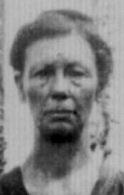
Roy’s mother, Amanda Elizabeth Leffert Tate, died in 1938, so the residents of the home at that time would have been Joseph Fred Tate, Roy’s dad, Roy, Pauline, Charles, Pauline’s younger brother, Charles, and, perhaps, for a short time, Roy’s wife, Mabel.
Pauline’s youngest brother, James, lived with their father, John Wesley Leffert, a carpenter, in a house just a short walk down the dirt road from the Home Place. The 1940 Federal census indicates that they had lived there in 1935-1940.
In the 1940 census, Joseph F and Roy Tate, and Pauline Leffert, were shown living in Liberty Township, on the George W Palmer farm, and that they had lived in the same location in 1935. Fred and Roy were employed in those days as laborers on Palmer’s farm in the Bay Island Bottoms, on the River Road, north of Hannibal, and had worked there for several years.
1940 Census
The 1940 census shows Joseph F, age 66, widowed, living with Roy D, age 28, and Pauline Leffert, age 16, in Liberty Township, and that they had lived there for at least five years. Since they were at this same location during the 1930 census, we know that they were there on the farm for at least ten years, and that they were there at least three more years before moving to the Donaldson farm.
Neighbors of George W Palmer included Henry Wagner, William M Schenck (spelled Shanks on census), his wife Rosalie (sic), and sons Albert and Orbert. Another neighbor, William E Schenck, (spelled Shanks on census), his wife Rosabelle E, and son William R were nearby.
1941
Robert and Roberta Births
Roy and Pauline’s firstborn were twins, Robert Leroy and Roberta Lucille Leffert, who were born 22 Feb 1941 at Emma Ann Tate Jennett’s residence in Palmyra MO. Lucille was a “blue baby” and lived only three days. She was buried in a simple, velvet-lined wooden box fashioned by Pauline’s father, John Wesley Leffert. The burial took place on a knoll behind the Homeplace garden plot at the edge of the woods.

1942
In the summer of 1942, while World War II was raging, Roy and Charles were employed by George W. Palmer to work on Palmer’s farm in the Bay Island Bottoms, on the River Road, North of Hannibal.
Roy moved his family to what Pauline described as a “shack” on Palmer’s farm to be closer to his work. Bill Jennett was working for Warren Head at the Estelbrook Dairy in Palmyra. His wife is listed as Mrs R.E. Jennett in the city directory.
1943

1944
In 1944, Roy and Charles found work on the Donaldson farm on West Ely Road nearer Hannibal, and Roy rented quarters for his family in a small house on the farm. It was shortly after they located there that a full time position opened up on CB&Q. In June, Roy’s brother, Charles Frederick, got Roy hired full-time onto the Chicago, Burlington and Quincy Railroad as a switchman, working in the yards where trains were made up for distant locations.
Roy moved to Hannibal near the CB&Q RR yards, where he would be working, and rented a dry-docked houseboat on the banks of Bear Creek at 619 Ely Street in Hannibal to serve as his residence. It was located across the street from relatives, and was pretty close to work.
The houseboat was within hearing distance of the switch yards, where Roy reported for work, and since he did not want to learn to drive an automobile, he was able to walk, ride with other crew members, or take a taxi to work from this location. Shortly after moving to Hannibal, James Wesley Tate was born, in August of 1944.
1945
In June of 1945 Roy’s older brother, Charlie, had become a section foreman and got Roy hired onto Charley’s track gang, which was dispatched out of the CB&Q switch yard in Hannibal.

Rear of Union Depot, Hannibal MO, 1945

Christmas Eve Night Shift
On Christmas Eve, 1945, Roy was working as a switch tender in the CB&Q switching yard in Hannibal. His job was to keep the coal oil lamps on the switches filled with oil, and burning, so the switch locations could be seen in the dark, and then throwing the switches so the engine could sort through the cars and make up trains.
It was so cold that night that his weather toughened skin was numbed to the bone. He had already spent several hours building and maintaining small fires to warm the switch points and throw-bars to melt the ice that relentlessly gripped the switches in locked positions throughout the yard, preventing the make up of trains. The switch levers had to be freed so they could move back and forth to direct freight cars onto the desired tracks.

Walking in the rail yard was always tough. At night it was even worse. Roy carried a kerosene switchman’s lantern to illuminate his way. The gravel crunched, shifted and scattered as he walked.
Evidence of track maintenance laid strewn about the ground in the deep shadows between tracks. Abandoned rail joiners, tie plates, and chunks of old ties lay precariously in the dark. Roy had to watch his step closely to avoid tripping and falling.
The only other light in the rail yard was given off by the wicks of dim coal oil fired switch-marking-lamps, casting red and green pools of light over the switches they guarded. The green and red lenses indicated whether the switch was aligned to the desired track.
The huge switch engine moving the boxcars around the rail yard to make up tomorrow’s freight trains, chuffed and spewed huge clouds of steam into the crisp air, often blinding Roy momentarily as the engine’s brilliant headlight sliced through the darkness.
Roy had to concentrate to quickly readjust his eyes to see obstacles on the ground, but couldn’t waste any time getting to the next switch, or everyone would have to wait for him. While walking alongside a string of moving cars to get to the next switch he had to throw, he felt a crushing blow to his left jaw.
Reeling dizzily from the blow, he quickly regained his balance, and realizing that he had been struck by something hanging from a boxcar, instinctively raised his hand to his face.
Something didn’t feel right. At the same time he pulled his gloved hand away to see if the blow had drawn blood, he thrust his tongue into his cheek. Just as he realized that his tongue had gone through his cheek into the freezing night air, his eyes were focusing on his gloved hand, which was completely covered with blood. He glanced down at his jacket and saw blood running down his chest.
He walked as quickly as he could to the yard office where he examined the injury in the mirror. The deep wound started at the back corner of the left eye, made a fishhook curve to the front of the cheekbone, and then ran down to behind the corner of his mouth. It was cut to the bone. It needed stitches.
He took a taxi to the hospital to get the wound treated, but wouldn’t let them give him a sedative, because he wanted to go back to work. He got about forty stitches in the wound, and said that it was so cold that night, once he got back to work, the cold numbed his face, and he didn’t feel any pain the rest of his shift.
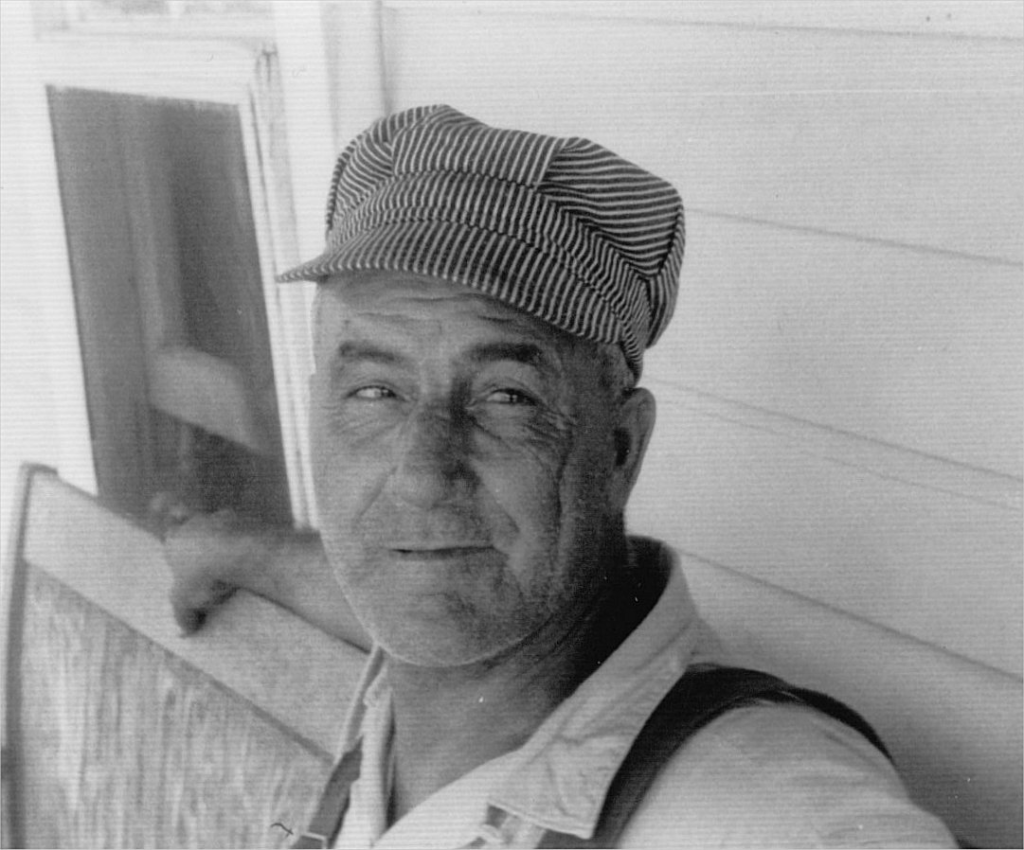
CB&Q Construction Sites
Helton Station

Helton is an unincorporated community in Marion County, Missouri. A variant name was “Helton Station,” the railroad name for the site. Helton is the first station north of Lamb on BNSF Railroad, according to the 1925 map of the area. It is situated in Sec. 35, Twp. 58 N, R. 5 W on 168 north of Mungers. It has no population.
The converted chair cars shown above were situated on the siding at Helton Station in 1927. Charley and Clara Tate were living here at the time of Delbert’s birth. One can only imagine how cold those concrete floors were during a Missouri winter!
Mark Station
At one time, some of the Tate’s extended family lived in portable housing at the Chicago, Burlington, & Quincy Railroad’s Mark Station, near West Quincy. We know this was prior to 1938, because Roy’s mom, Amanda was in one of the photos that has survived. Mark is now an extinct town in east Marion County.
Mark was the first CB&Q RR station north of North River and just west of the Mississippi River in Marion County, Missouri. Mark is now an extinct town. A post office called Mark was established in 1914, and remained in operation until 1927.
The community was named for an investor in the site which kept experiencing disastrous spring floods. Later it was known as “Dunsford,” and railroaders called it “Moody” for the frequent spring flooding that played havoc with their schedules.

Mark Station was situated at a CB&Q double-tracked wye, or reversing loop, with east and west sidings for storage of railroad equipment, or passing of trains. It was 13 miles NNW of Hannibal, on the west side of the Mississippi river. The railroad wye is a triangular junction that allowed trains to switch from one track to another, or reverse direction, while keeping the locomotive at the head of the train.
The Mark wye was strategically placed a little under four miles south of the Missouri-Illinois bridge at West Quincy, and joined the CB&Q rail lines from Kansas City with those from St. Louis and the Chicago area.
The Mark wye had a two mile long double-tracked siding on the west side, leading to Kansas City through Monroe City, Shelbina and Macon. The east leg was also double tracked for 1.5 miles, starting two-tenths (.2) of a mile north of the two-section Warren Truss bridges over North River, and joining nearly four miles south of the Mississippi River bridge to Quincy, Illinois.
There was also a ladder-track switching yard on the south side of West Quincy, and another, much smaller, 1200 foot long wye to the north, just on the Missouri side of the Mississippi. That wye is so small that it was probably used only for turning engines around and routing trains.
It’s also interesting to note that the Mark wye was located 5 miles south of Taylor, and about six miles east of the Homeplace, so it was fairly easy for the family to get together occasionally.
Mark Bottoms

The Mark Bottoms was an area on the west side of the railroad tracks that created the wye, and in the bottom land near the South Fabius River. CB&Q RR had constructed a what appears to be a parallel work-gang siding with a long row of of portable houses along the track.
Traces of the long gone siding can still be seen in satellite images of the area. The housing was very close to the track, and this was in the era of steam engines, which sent large billows of scalding hot steam out to the sides. A locomotive stopped here waiting to throw the switch giving access to the siding, would have huffed and chuffed and exhausted a lot of steam to get underway.


Harry Cook, who married Amanda Elizabeth Tate, worked at times on various track gangs for CB&Q, and he and Lizzy also lived in the converted chair cars at Mark Station. Their daughter, Goldie, was born at Mark Station as shown on her birth certificate. Harry later became a member of Charley Tate’s permanent track gang based in Hannibal.
Mabel Maudell Taylor

Mabel Taylor, a cousin to Pauline Leffert, was married six times during her lifetime, twice to Roy Tate, who was her second and third husband. Roy married Mabel in 1936, and again in 1938. She had first been married in Marion County, Indiana to Vernon Barlow in 1929. Evidently that relationship didn’t work out, as she moved in with her uncle John Leffert, to take care of the children after John’s wife, Blanche, died in 1933.

Mable remained in the Leffert home until John and the children moved to Missouri. She remained behind to keep her job, which were difficult to come by during the Depression. In 1936 she went to Missouri to visit John and the family, and met Roy. She told Leona, Roy’s daughter, in later years, that she married Roy because he was handsome, and divorced him because she got bored living out in the country. According to Pauline Leffert Tate, Roy and Mabel lived together for six years before getting married. The marriage lasted only six months, and she returned to Indianapolis..
Mabel returned to Missouri in 1938, and rekindled her romance with Roy. After a short courtship, they were remarried at the Palmyra courthouse by a judge. After only a couple months, Mabel miscarried a pregnancy. This time Roy divorced her, and again received a divorce in Common Pleas court.
Mabel Taylor Tate Interview
The following is a written statement submitted to Larry E and Leona M. Tate Vaughn while researching the Roy Tate family history March 27, 1994. The original, in Mabel’s handwriting is digitally preserved and attached as an addendum. Answers to questions regarding the history of the Pauline Leffert/Roy Tate family given by Mabel Maudell Taylor Farlow Tate Johnson Feese, Roy’s first and second wife.
“My mother and Dad separated when I was only 14 years old. My Dad moved to Florida after their divorce. My mother died in June 20, 1926. I was practically “an orphan” at 15 years old. Since the Lefferts and Tates were close in family ties, I thought my life would be reasonably happy, but I didn’t find it so after I moved to Missouri for that short time.
Probably had too much AMBITION in younger days? High school probably was partly the cause for the drastic change. Because I can look back over the years and think of all the good things I have accomplished. I even surprised myself as to how far up I have climbed since I moved back to Indianapolis, Indiana and Florida.
P.S. I do remember several skeletons in the family closet that I could tell you about. But, since I can’t prove any of it for sure I would rather let the “bones” rattle by themselves. I never did have a sister of my own, either living or dead. But, Pauline has seemed like a little sister to me and I did have that pleasure in life. My mother and her mother were sisters, though.
I always liked our Grandma Roberts. She was a small, feisty, woman. I have white hair exactly like hers now. I have gone to Spiritualist Churches and received messages from Grandma Roberts, my mother and Pauline’s mother. They were always in a group together. Someday I hope to see them again (when I get over to “the other side.”)
What was your maiden name? Mabel Maudell Taylor
What was your date of birth? September 29, 1910
Where were you born? Indianola, Illinois
What was your father’s full name? Van Buren Taylor (his mother was born in England)
What was your mother’s full name? Luella Roberts Taylor
Where did you live when you first met Roy Tate? Indianapolis, Indiana
How did you and Roy first meet? I made a trip to Missouri.
How old were you when you met him? About 18 years of age
Where did Roy live when you first met him? With his mother and Dad in Missouri
Where did the Lefferts live? Some in Indianapolis and some in Missouri
Did the Tates and Lefferts work together? As far as I know
What events brought the Tates and Lefferts together? Probably when Uncle Fred and Aunt Mandy married.
What was Roy’s occupation when you met him? Farming
Where did he work when you met him? Can’t remember
What did he do that attracted you to him? He was nice looking and very polite and about the same age as me
Did you date very long before becoming engaged? no
What was your courtship like? Very nice
What were your favorite things to do together as a couple? We lived on a farm and went to town occasionally
When and where did you get married? Can’t remember the date, except in Hannibal, Mo
Who performed the ceremony? I don’t remember
Who was present at the ceremony? no one except Roy’s mom
Where did you live after your marriage? with Roy’s parents
How did you spend your time in those early days of your marriage? At home or in Hannibal, Mo
Where were your favorite places to go? to Roy’s kin folks
Do you remember visiting any cemeteries where Tate relatives were buried? At Hester Cemetery (Near Palmyra Mo)
Do you remember where they were? North of Hannibal Mo
Did any pregnancies result from your first marriage to Roy? No
Why did you and Roy first divorce? There was jealousy in Roy’s family. Also in the Leffert family for no good reason. Always did think the cousin part of their When and where did that divorce become final? I don’t remember. It was after I went back to Indianapolis, In.
Where did you go, and what did you do after your first divorce? I went back to Indianapolis after the 1st time and I went back to work.
What did Roy do after your divorce? Stayed with his Dad & Uncle John Leffert.
How long were you divorced the first time? Not very long
Why did you get back together? I thought I loved Roy, and we would always love each other
What was the date of your second marriage to Roy? I don’t remember
Where did the ceremony take place? I don’t remember the name of the Justice of the Peace in Missouri
Who performed the ceremony? I don’t remember his name
Where did you live after your second marriage? A short time in Missouri
How long were you married the second time? Not very long
Did any pregnancies result from the second marriage? No
What circumstances brought Roy and Pauline together? Living together in the same house in Missouri. We lived with Uncle Fred and Uncle John Leffert.
Were there any factors other than Pauline’s pregnancy that contributed to the second marriage’s failure? I didn’t know she was pregnant until after the twins were born. I knew by Bob’s picture that he is Roy’s son.
What was the family’s reaction to Pauline’s pregnancy? I don’t know. I had moved back to Indianapolis.
Where did the Lefferts (Pauline’s family) live at the time? In the Bay Bottoms
Were the Tates and Lefferts socially active with each other? No. Aunt Blanche and her folks lived in Broad Ripple (Indianapolis, In)
Were there animosities between the Tates and Lefferts? Not that I know of.
Why were the twins born at Roy’s sister’s home, rather than in a Leffert home? I don’t know. Aunt Blanche died around 1934 before Pauline and her Dad and brothers moved to Missouri.
Where were Pauline’s mother and father during this period? Pauline’s father was living in Mo. Her mother was dead.
Why were you and Pauline able to continue through the years as friends? I felt rather guilty leaving Missouri, and Pauline, as she was so young – she was about 16 years old)
When were you divorced for the second time? I don’t remember
What did you do after your second divorce (where did you go, etc.)? I went back to Indianapolis to live, as I could not see my through living in Mo. Besides, Pauline and Roy were in love with each other.
Roy’s father was FREDERICK JOSEPH TATE. Is this correct? Yes
Did he have a nickname? Not that I know of
What did he do for an occupation? mostly farming
Do you remember his father’s name? No. I don’t think I ever knew.
Do you remember his mother’s name? No
What do you know of Roy’s Dad’s background? Nothing
What do you know of Roy’s mother’s background? Nothing
Do you know where the Tate family came from before settling in Missouri? No
Are there any other comments or thoughts that should be included in the family history? I feel that Tate is an English name. My maiden name was Taylor and it is English. A lot of information was destroyed by floods. Also there was a fire that destroyed Pauline’s and my grandmother Roberts family bible in Missouri when she and her Dad and brothers went back to Missouri to live after Aunt Blanche died in Broad Ripple (Indpls) Indiana, in 1934, I think.
Pauline and I are the only 2 granddaughters in the Roberts family. Pauline had a baby sister, Elizabeth, born between her and her brother Charles Leffert, but she died when only six months old.
I lived with her (Pauline) and her mother and Dad in Broad Ripple (Indpls) Indiana when Pauline was only about three years old. Pauline always called me “Sis.” I think of her as a little sister, but she is a first cousin of mine. Her Dad used to tell her that I was cousin Mabel.”
2nd Interview with Mabel Taylor
Interview 8:00 a.m. April 23, 1994 with Mabel Maudell (Taylor) Freese, age 83, at Comfort Inn, Orange Park, Florida. Interviewed by Larry Vaughn, Tate family researcher, accompanied by Lea Tate Vaughn, his spouse. This was a rambling conversation, intended to gather general information. The conversation has been reorganized into general chronographic sequence.
James Leffert, 808 E, 63rd St., Indianapolis, who was John Leffert’s uncle, lived with his widowed sister, Jemima (Aunt My’me) (Leffert) Michener. It is unknown where Henry Michener, Jemima’s husband, is buried. (Editor’s Note: His grave has been located in Farley Cemetery)
John Leffert, Indianapolis, & Nellie Michener, Jemima’s daughter of Carmel, Indiana, were first cousins. They wanted to marry, but were not permitted to by the family.
Jemima lived on 63rd St in Indianapolis. She smoked a clay pipe all of her life. Nellie, Jemima’s daughter, was sick for many years of an unknown illness, and died at age 17 or 18. She wore her hair parted in the middle, slicked back, tied in a bun. After Nellie’s death, Jemima kept Nellie’s clothes in a trunk at the foot of Nellie’s bed in her vacant bedroom.
I (Mabel) went to visit Aunt Jemima one sweltering summer day, intending to spend the night. “Aunt Mymie” told me that I could sleep in Nellie’s room. We got to talking about Nellie, and Jemima opened up the old trunk to reminisce. We sat on Nellie’s bed looking at the old, crumbling, clothing . . . old fashioned floor length taffeta dresses, petticoats, pinafores, stiff collars. After the conversation, “Aunt Mymie” left the room and closed the door behind her as I prepared to retire for the night.
The single window in the bedroom was open to admit any cool breeze that might stir. There wasn’t much hope, however, as the heat had been sweltering all day, and the night didn’t look like it was going to be any cooler. There wasn’t a wisp of air moving. I lay upon Nellie’s bed and eventually fell to sleep. I was awakened during the night, and felt very cold. I felt a freezing cold draft move across the bed. I looked at the curtain at the window. They hung motionless. There was no breeze.
I had a fear come across me, and thought I had maybe taken sick. I sat up. The draft stopped, and the sweltering heat returned. Then the freezing cold returned. Frightened, I got up and hurried to Jemima’s bedroom. When awakened, Jemima asked me, “What’s wrong with you child?” I told her, “I’m freezing. Can I sleep with you?” I slept with her that night, and never slept in Nellie’s room again. I know that Nellie was in the room that night, and she didn’t want me sleeping in her bed.”
Mabel attended a Spiritualist Church where she was part of a Spiritualist Session, She sat on the end of a rectangular table at which several other persons were seated. She was skeptical, and wanted to look under the table to see if anyone was playing tricks.
The table commonly lifted up off the floor during “spirit contact,” tilting once to signal “no” and twice to signal “yes.” When it was her turn, she asked how long she was going to live. The table tilted 92 times. She looked under the table, and saw no one playing any tricks. She stated that she had gotten messages from her Aunt Jemima, her mother, and Pauline’s mother at various times during these sessions. The three ladies, Luella, Jemima and Blanche, are always together, it seemed.
The Carmel, Indiana American Legion used to hold a special military ceremony at the Farley Cemetery on June 1, decoration day. They have a lot of the Farey history. Mabel used to attend the festive ceremony regularly.
Amanda Leffert, Roy’s mother, was 5’8”. . . as tall as her husband, Fred. Pauline and Mabel’s mothers, (sisters), were fairly short. Pauline’s mother was Blanche Roberts. Mabel’s was Luella Roberts. Pauline’s father was Roy’s mother’s brother. Roy and Pauline were first cousins. Mabel and Pauline were also first cousins. It is believed that Fred & Amanda’s marriage first brought the Tates and Lefferts together in marriage.
After Blanche died, John moved his children to “Uncle Fred and Aunt Mandy’s” in 1934. He joined them in 1936. Pauline was about 9 or 10 years old when John sent her to Missouri.
Elizabeth, Pauline’s sister, was born between Pauline and Charles. She died at the age of six months, in about 1926. She is buried at Farley cemetery, beside Blanche, in an unmarked grave.
When John took his children to the train station in Broad Ripple, bound for Missouri in 1934, he knew that Uncle Fred and Aunt Mandy were going to meet them at the station in Hannibal. John bought identical suits for the boys to wear on the trip.
They caught the train in Broad Ripple, near their home on 64th street. Fred & Mandy lived at the Homeplace. Roy and Harry (Cook) were working for Young and Guardhouse, two farmers in the area. Charlie, Roy’s brother, had married Clara and had two sons. They lived on George Shear’s farm.
Pauline’s brother, Charlie, went to live with Bill & Emma. Her brother James was supposed to stay with Fred & Amanda, and Pauline with Rosie & Willie. But Jimmie, age 4, cried at the thought of Pauline being gone, so Fred & Amanda let Pauline stay with them, too.
Mabel, age 14 or 15, went from her home in Indianola, Indiana to Broad Ripple to live with her Uncle John and Aunt Blanche, when her parents divorced. She stayed with them until Blanche died (1933) and John moved to Missouri (1936).
Mabel made a vacation trip to Missouri to see her Uncle John and “the kids,” (Pauline, Charles and James). She met Roy at that time. Mabel is September to April (7 months) older than Roy Davis Tate, her second and third husband. She was married first to Vernon Barlow, Indianapolis. They stayed married only a few months. After their divorce, Mabel lived and worked in Indianapolis.
Asked why she married Roy, she said that she was young, dreaming of having her own home, and being around her relatives. She married Roy, even though he didn’t have a good job. He was doing farm labor for farmers around the Home Place, and lived with his mother and dad, during their first marriage.
During Mabel & Roy’s second marriage, Mabel and Roy lived with Roy’s dad and Mabel’s Uncle John Leffert, who now lived at the Home Place. The two had come to live together after losing their wives. Fred’s wife, Amanda, died of “tomato poisoning” (gangrene) and John’s wife died of cancer.
“The Tate & Leffert families living together at the Home Place is what was wrong with the whole thing. Pauline was crazy about Roy. He was handsome, with his curly hair. She was 16 or 17, quite pretty, and sat in his lap all the time, just to be close to him. He was my husband, but she was really in love with him. You could just see it. I thought it was cute at first, but I didn’t think it was right.”

“I wanted Roy to move away to town, but we couldn’t, because he didn’t have any work. By then Pauline and Roy were really in love. That’s why I had to leave.” After I left, Rosie sent me a picture of Bob, and I knew it was Roy’s baby; he looked just like him.”
“At one time the Tates and Lefferts lived on the Willie and Rosie Schenck farm, on Bay Island, in a two story house. Three families lived there: Fred & Roy Tate, John Leffert and kids, and Harry & Elizabeth Cook; Emma and Bill lived on the nearby Kennedy farm (Bill’s son, Raymond, from Iowa, lived with them for a short time). Raymond was by Bill’s first wife.”
“Harry & Lizzie (Roy’s sister, Elizabeth) once lived at the Home Place with Fred & Amanda in the 2-room cabin where it is now located. Fred & Amanda, Roy, Harry & Lizzie all lived in the cabin. Harry & Elizabeth Tate Cook had a daughter, Goldie, who was Carolyn’s (Carl Tate’s wife) mother. Goldie was part Leffert, and part Tate, just like Roy, and now Carolyn and Carl are the latest cousins to get married.”
“Earl married Elsie in a wedding in the Mark Bottoms. Maggie & Tom, Rosie & Willie, Harry & Lizzie, Bill & Emma, were all married and gone from the farm, and most had their own kids by then. Some of the family worked repairing CB&Q track at Helton Station, Mark Switch, West Ely, and other places around. I think Roy’s brother Charley was the first one to get full time work on the railroad.”
Clara and I used to pal around a lot in Missouri. One time Clara came to visit me at my home in Indianapolis. I had to work all day, and left Clara at home alone. One evening I returned home to discover that the clothes hung in my closet appeared to have been moved around.”
“I didn’t mind that, but upon closer inspection, saw that my favorite blouse, red-white-and-blue, was missing. I had planned a trip to Missouri on American Airlines, which had a red-white-and-blue color theme back then, and I thought my blouse would make the trip really special. I was looking forward to it, and had my heart set on wearing it.”
“When I asked Clara, however, she denied having seen or taking the blouse. Only Clara could have taken that blouse, and I knew that she was lying to me. I knew she didn’t have anything as nice as that blouse, and that she probably just couldn’t, resist it. I was very hurt, and very upset. Clara stood her ground, so I told Clara to leave and never come back. She wasn’t welcome any more. I never saw the blouse again, and l never forgave Clara, either.” -End of Interviews –
Mabel was a strong-willed and outspoken person. When she related the above story to us, she was still visibly angry over the disappearance of that blouse. Yet, her personality lit up the room, and she was instantly likeable, though she was not one to mince words. We enjoyed knowing her during the few years we corresponded and visited her at Moosehaven. She died 2005 at the age of 95, and is buried in the Moosehaven cemetery.
May Pauline Leffert Tate
Pauline Tate Interview April 27, 1994
NOTE: This information was derived from a prepared interview with May Pauline Tate, April 27, 1994. Handwritten notes taken by the interviewer, Larry E Vaughn and Leona M Tate Vaughn, were transcribed into typewritten form, and submitted to Pauline for revision or correction. This transcript is the result of that process. Additions by the editor are shown in italics.
1923
May Pauline Tate was born to John Wesley and Blanche (No Middle Initial) (Roberts) Leffert in 1923. The birth took place in their home in Broad Ripple, Indiana, overlooking the shipping canal that ran into downtown Indianapolis. That home no longer stands.
John was a carpenter by trade, and had moved to Indianapolis from the Quincy, Illinois area several years before to find work. He worked at a variety of sites, and for a number of employers. It is not known how he met Blanche, nor any history of their marriage, as of this writing.
John Wesley Leffert’s parents, Charles Leffert and Sarah Lewis resided in the Quincy IL area. Pauline believes she remembers her father commenting that his parents are buried in unmarked graves at Hester Cemetery. The Cemetery’s records were lost when the Christian Church building burned.
Blanche Roberts’ parents, Dudley and Margaret (Farley?) Roberts were from the Indianapolis area, and are buried in Farley Cemetery, Carmel, Indiana. Charles Robert’s brother, James Robert, and sister, Jemima ( Roberts) Michener, also lived in the Indianapolis area in 1930s. Jemima is buried at Farley Cemetery. Her daughter, Nellie, is buried beside her. Pauline knew these relatives as “Uncle Charlie” and “Aunt Mimie (My’me).” Pauline’s “Great” Uncle James Michener, age 90 at date of death, is interred next to Aunt My’me (Jemima).
Mabel Taylor’s parents, divorced in 1925, when she was fifteen years old, and Mabel found herself at liberty to follow her own path. She moved to Indianapolis to live with her mother’s sister, Aunt Blanche and Uncle John Leffert. Mabel Taylor was a niece to John Leffert, as her mother, Luella and Pauline’s mother, Blanche, were sisters. In 1925 Pauline was 2 years old. She came to call Mabel “sis” although John, her father, kept telling Pauline that Mabel was a cousin. Pauline still called Mabel “sis” throughout her lifetime.
Luella Roberts Taylor and Blanche Roberts Leffert had a sister, Rose, who never married. Pauline recalled that Aunt Rose might have been retarded. She had a separate entrance to their house on the canal, and the children did not interface with her much. She never married, and is buried in Farley cemetery.
Pauline attended school in a building right across the canal from their home. She recalls dreading crossing the canal to go to school. The mean boys on the other side of the canal always picked on her and the younger boys. She had, however, fond memories of the motorized canal boats plying their wares past their home on a daily basis, and the steam-operated trains stopping at the depot near by.
1933
Pauline’s mother, always seemed to have a burning pain in her stomach. It was unknown what caused the pain, and no treatment seemed to quiet it. The pain, as Pauline remembers, centered just below the heart, at the top of the abdomen. Doctors were unable to stop the discomfort. In 1933, when Pauline was ten years old, her mother went to an Indianapolis hospital for exploratory abdominal surgery, and died on the operating table.
Pauline recalled hearing that when the doctors opened her mother, they discovered that she was terribly diseased, and that nothing could be done to save her. Death is believed to have been a result of intestinal cancer. Blanche is buried in the Farley family cemetery in Carmel, Indiana.
A man by the name of Frank Cobb helped John a great deal after Blanche’s death. It is not known whether he was just a friend, or an official involved in settling the estate.
After Blanche died, Mabel Taylor, age 23, gave up her home in Indianapolis to come to stay with Pauline, her father, and Pauline’s younger brothers, Charles and James. She helped care for the children while John worked. Pauline has fond memories of walking along the banks of the canal to pick flowers with Mabel, whom she called “Sis.”
1934
In mid-April of 1934, John Leffert put his children Pauline, Charles and James on a passenger train at the depot near their Broad Ripple home, and sent them to Missouri where they would live with relatives. Charles and James wore matching suits purchased especially for the trip. Mabel, age 23 in 1934, was working in Indianapolis, and chose not to move to Missouri. This was mid-depression, and a good job was very difficult to find.
John had made arrangements through his sister, Amanda (Leffert) Tate, for his children to stay with Tate family members for a period of time, until he could settle his affairs and relocate back to the Missouri area. It was arranged for James to stay with Amanda’s daughter Rosie & husband Willie Schenck. Charles would stay with Amanda’s daughter Emma and husband Bill Jennett. Pauline would stay with Fred & Amanda.
Guardhouse Farm
All three families worked as farm laborers, and lived in close proximity to each other in the Taylor, Missouri area. Fred and Amanda had a two-room house on a small plot of land Fred owned near Taylor, Missouri. Roy was the youngest of Fred & Amanda’s children, working as a farm laborer for Harold Guardhouse. Pauline worked for several years as a housekeeper and baker for the Guardhouse family.
Earl Dearing Farm
Roy’s brothers and sisters had all moved from the Homeplace by 1934. Fred was working as a farm laborer on the Earl Dearing farm, and raising a few hogs of his own in the ravine below the house. This property was the birthplace of Roy Davis Tate, and contains a family burial plot with several unmarked graves of infants, including Roberta, Pauline’s firstborn. The property is still in the Tate family, and is known today as the “Homeplace,” or, “The Camp.”
Fred and Amanda met the Leffert children at the train station in Hannibal when they arrived. Fred and Amanda were brought to town to meet the train by Harold Guardhouse, for whom Fred & Amanda’s son, Roy, worked. Fred & Amanda had no automobile. Transportation for farm laborers in that era was either by foot, or horse and wagon.
The Leffert children were brought back to the Homeplace where they were met by the families who were to provide them homes. Charles went to Emma & Bill’s home, a small house overlooking the Fabius River, just 1/4 mile down the gravel road from the Homeplace. This home was later destroyed by fire.
Six-year-old James threw a “regular fit” at the prospect of Pauline leaving him alone in his strange, new home to go live with Rosie & Willie. He persisted with such fervor and passion, that Fred & Amanda agreed to let Pauline also stay with them. The 2-room house was then home to Fred, Amanda, Roy, Pauline, and James.
It is unknown what arrangements John made for his sister-in-law Rose, who lived in his home during Blanche’s lifetime.
1935
When John Leffert moved to Missouri, he took up temporary residence at the Homeplace with Fred, Amanda, Roy, and two of John’s children, Pauline and James. In a short while John was able to find a farm laborer job on the Stewart farm in the Bay Bottoms, between Hannibal and Palmyra. He rented a house on the farm, and he, his children, and Bill & Emma (who at that time had no living children) took up residence. The children attended Marion City school, walking about 1 ½ miles each way.
1936
In 1936, Mabel Taylor and Roy Davis Tate were married after having lived together for six years. The ceremony was performed at the Palmyra Courthouse by a judge. The marriage only held brief interest for Mabel, however, as she quickly grew tired of rural life, and could not convince Roy to move into town. She left her husband behind after only two months of marriage, and returned to Indianapolis. Roy filed for divorce.
Stewart Farm
The John Leffert and Bill Jennett families lived on the Stewart farm for two years, while John and Bill labored on the farm. John paid the rent on the house, and often complained that Bill was not paying his fair share of the bills. This friction fueled frequent quarrels, and grew into a major disagreement by 1938, which concluded when John told Bill to move out of the house.
Raeger Farm
Bill moved his family to the Raeger farm, later moving to Huntington, where Charlotte was born, and then to Palmyra, then Frankfort, where Donald was born, and finally to Hannibal, where Sharon was born. Emma lost eleven babies, including Thomas, who died at the tender age of two. Family tradition holds that he ate or drank rat poison, but everyone said he died of Whooping Cough. He is buried in Hester Cemetery.
1938
Kenneth Jones Farm
In the winter of 1938 John went to work for Kenneth Jones, and moved himself, Charles and James to the Maywood Farm. Pauline graduated 8th grade, along with the other two girls in the 1938 class, from Suddeth school.
Palmer Farm
That summer Pauline & Charles moved in with Fred & Amanda and Roy, into the tin house on the Palmer farm in the Bay Bottoms. The house, much like a pole barn, had four rooms, and a total of 2 windows. Although the house was formed only of wooden poles with tin roofing sheets attached to them, it was larger than the old cabin at the Homeplace.
Pauline related that there was no insulation of any kind in the house, and the walls were always as hot or cold as the outside air. Cardboard nailed up between the poles formed the interior walls. In the winter time, snow would blow through gaps between the sheets of tin and the poles. The snow would actually pile up on the dirt floor inside the house.
When the heat from the cook stove was enough to melt the snow on the inside of the house, it created a spot of mud. When it got real cold in the winter, the single little wood cook stove couldn’t keep the cabin warm. Pauline recalled that when she was cleaning up the kitchen after a meal on those cold days, she kept the dish water pan warmed on the stove. She would wring out the wash cloth in the warm water, and by the time she turned around to wipe off the kitchen table, the wash cloth would already have started to freeze!
Lennard Jones Farm
Pauline’s father, John, and brother James moved to the Lennard Jones farm. In Maywood (?) Pauline, age 15, refused to move with her dad away from Roy. She was in love with Roy, twelve years her senior, and was determined to stay with him. John objected violently to Pauline’s affection for Roy, but could not convince her to change her mind.
He and James moved to their new home, while Charles and Pauline stayed with the Tates. John’s house caught fire about a year after taking up residence, and all the family photos and memorabilia were lost. Among the items lost was Aunt Jemima’s family bible.
Donaldson Farm
In May of 1944, Roy and Charlie Leffert left Palmers and moved to the Donaldson farm on West Ely Road near Hannibal
1938
Death by Lockjaw
While working around the farmhouse garden spot on the Palmer farm, Amanda contracted “tomato poisoning” on her legs, an allergic reaction to the tomato vine, which progressed into immense sores, and later into gangrene.
Since doctors would no longer come out to the Bay Bottoms to see a patient, Amanda had to be taken into town for treatment. Her daughter, Rosie, took Amanda by horse and wagon to see a doctor. Treatment evidently came too late, since Amanda contacted “lockjaw” and died in Rosa Lee’s home in Palmyra. She is buried in Hester cemetery.

The residents of the Bay Island home after Amanda’s passing would have been Joseph Fred Tate, Roy’s dad, Roy, Pauline, Pauline’s younger brother, Charles, and Roy’s wife, Mabel. Pauline’s youngest brother, James, lived with their father, John Wesley Leffert, a carpenter, who had moved to Maywood, a few miles north of Hester.
The Bicycle Story
Roy and Pauline’s brother Charles used to work together when they lived on the Palmer place, and used to ride to work on a bicycle. Charles would sit on the seat and steer the bike, while Roy sat behind him and peddled. On day, Roy decided to learn to drive the bike by himself. He got it going, but found that coordinating the steering and balance at the same time to be a problem. He started off from the small yard, and got headed down the bank, and rode right into the Bay!
Roy earned $9 a week working for Palmer, and Charles earned $2 a week. Roy was older, much brawnier than Charles, and was able to perform heavy work all day long. But, Charles was a hard worker, and always felt that he should earn more than he was getting. Late in 1944, Donaldson offered Roy $20 a week, and Charles $9 a week. That was motivation enough for them to move from Palmer’s Farm to Donaldsons’.
Mabel (Taylor) Tate returned to Missouri after the Tate family moved to the Palmer farm, and rekindled her romance with Roy. After a short courtship, they were remarried at the Palmyra courthouse by a judge. After only a few months, Mabel she returned to Indianapolis. Roy again received a divorce.
1941
Robert & Roberta were born to Pauline, February 22, 1941, at Emma & Bill’s house in Palmyra. Pauline had gone into Palmyra to deliver her child, because doctors no longer traveled into the Bottoms to treat patients. Pauline had no idea that she was going to have a multiple birth, and the doctor, too, was surprised to discover the second child.
Roberta, a “blue baby,” was born first, at 3:00 p.m., followed fifteen minutes later by Robert. Roberta weighed just 3¼ pounds, while Robert was 5¼ pounds. Roberta lived only three days. Pauline’s father, John, fashioned a wooden box lined with white satin to bury Roberta. She was interred without ceremony in the Tate family plot at the Homeplace.
Roy’s brother Charles, and another brother, Earl, married sisters. Charley married Clara M. Stover, and Earl married Elsie Maude Stover. Clara and Charley had taken Earl’s children, Lula Belle, age 7 Dorothy, age 10, and Roy Lewis, age 3, after Elsie died. Earl became an alcoholic, and could not provide an appropriate home for the children.

In 1941, Clara & Charles asked 17 year-old Pauline Leffert, herself a new mother, to care for Earl’s children for a couple of weeks for them. Pauline agreed, but the two weeks extended to three years, and Clara & Charles never did take the children back.
Earl Tate collected his children from Pauline in 1944, feeling that he could provide for them. He established a home in Hannibal. Earl was later accused, and convicted, of molesting his daughters, Dorothy, age 13, and Lula Belle, age 10. He was sentenced to two years in the Missouri state penitentiary.
Earl’s children were sent to the Hannibal Orphan’s home in 1945. His son, Roy Lewis Tate,later moved to the home of a Smith family in Palmyra, where he lived through high school. The girls were sent to St. Louis where they worked in a family’s private home.
Earl Leffert
There was a man in the area named Earl Leffert who stayed with a lady named Johnson at Maywood, MO. He was a brother to “Little John” Leffert, who was no known relation to our Grandpa John Wesley Leffert. They could have been cousins, but no one remembers the family connection any more.
Earl may have had a brother, Arthur (Art) Leffert. When Roy & Charles first got Roy’s ‘29 Model A, they went to visit Myrtle and Art Leffert, who lived in Maywood, past Hester. Hester was 9 miles from the Homeplace. So, there may have been some connection, but it is no longer recalled what it was.
The Model A
The 1929 model A Ford truck has a story behind it, too. Roy and Pauline’s brother Charles went in together to buy the old truck from Betty Leffert’s dad, Clayton Majors, for $50. The old truck had last been used as a wrecker, and had been scrapped. Majors, who ran a salvage yard, had purchased the truck as junk, as it had been severely scrapped.
Charlie, the adventurous one, normally did all the driving, because Roy had never felt comfortable behind the wheel. One night, Roy had been drinking, and decided he was going to master that old truck. He started it up, and was successful in getting it moving, but then found it difficult to steer. He went off the road “at a pretty good clip,” and wedged the truck in between two trees. Disgusted, he turned off the motor, walked away from the truck and resolved that he was never going to drive again.

The Model A was driven to the Homeplace to be used to haul water from the fresh water spring. A wooden box was built on the back to hold a 8-gallon milk can. Later, Charlie Leffert built the trailer seen above for additional hauling as construction projects kept popping up. In the background is the author’s 1971 American Motors Gremlin.
1943
Roy and Pauline were married by a judge in his Hannibal, Missouri office. Members of the wedding party included Joseph Frederick Tate, father of the groom, Dorothy and Lula Belle Tate, daughters of William Earl Tate, and Robert Leroy Tate, son of the bride and groom. John Wesley Leffert, father of the bride, and younger brother James did not attend.

1944

The Roy Tate family continued to live at the Palmer farm until May, 1944, when they moved to the Donaldson farm on West Ely Road near Hannibal. Later, in June of 1945 Roy went to work full time for the CB&Q railroad, later Burlington Northern, in Hannibal, Missouri. He was a switch maintainer, and later a track laborer. Roy’s brother Charles worked for CB&Q, and got Roy the job. Roy’s other brother, Earl, also worked for the CB&Q railroad, in the Mark Bottoms.

The Homeplace in this photo includes the tin roof believed to have been first installed in about 1957 when Charley F Tate and Charles W Leffert helped Roy Tate get the building back into shape for use as a getaway spot for the family.

View of the Homeplace original kitchen/dining area circa 1958. Notice the wood fueled kitchen stove bottom right and coal oil lanterns on the shelf. The original bedroom is the next room to the right. It also had a wood burning stove in it for heat.
Standing left to right- Roy Davis Tate and wife May Pauline Leffert Tate holding son Dennis Merrill Tate, and to her left is Charles Wesley Leffert, Pauline’s oldest brother. Seated left to right is Carolyn Leffert, daughter of Pauline’s younger brother, James J Leffert, son James Wesley Tate, behind the table is daughter Leona Marie Tate, son Carl Wayne Tate, Charles Leffert’s daughter, Gayle Leffert, and Roy’s sons Larry Davis and Robert Leroy Tate.
Sunset Valley Troubadors
For many years, Charles (Uncle Charlie) and James (Uncle Jimmy) Leffert had a country and western band styled after the Ozark brand of country vaudeville, with lots of silly jokes woven into the musical program.
Charlie and Jimmy played guitar, and both were vocalists. Their band, Sunset Valley Troubadors(sic), played at many rural social activities such as ice cream socials, community festivals, and church bazaars.
Often one or more of their band members would join us at the Homeplace, and sooner, rather than later, they would break out in song. It always made it a special evening when they “picked their way through a few tunes.”

Sunset Valley Troubadors Matchbook

Flood of 1973
This panel depicts the spring flood of 1973, and may be some of the most recent photos of the house at 905 Ely Street, which was the Tate home in 1961 when Larry Vaughn courted Leona Tate. The gold color house is 905 Ely. The photo at top left shows the flood water above the concrete porch on the front, while the top right panel shows the back entrance, on the side of the house, which opened onto the kitchen.
More of Charles Leffert’s Memories


GEOGRAPHIC NOTES ABOUT THE AREA:
Random data collected about other township and towns, villages and hamlets in the Hannibal, Palmyra, Taylor area. Many no longer exist other than in historical records.
LAMB
Lamb was the first CB&Q RR station north of East Hannibal.
MARK
Mark was the first CB&Q RR station north of North River. It was situated in Sec. 23, Twp. 59, R. 3 W near the Mississippi River.
MUNGERS
Mungers was situated on Sec. 6, Twp. 57 N, R. 5 W on 168 north from 61. Mungers is no longer listed in Marion Co. There is a Munger Street in Hannibal
NORTH RIVER – Fabius Township
North River was located on the Hannibal & St. Joseph R.R. at the crossing of the North River. There were station houses here and not much else. It was a post-office in the forks of North River, nine miles southwest of Palmyra.
This section of country was known as “Turkey Shin,” and “Turkey Run” because wild turkeys abounded, and regular hunting excursions were made by the early inhabitants.
NORTH RIVER STATION
It was a station on the H. & St. J. R. R., nine miles from Quincy (Ill.), and five miles north northeast of Palmyra.
SOUTH RIVER
South River is situated on Sec. 1O, Twp. 58 N, R 5 W on BNSF Railroad.
- It has no population.
- RAND MCNALLY, 1974.
WEST ELY
In 1836, with the establishment of the preparatory or the Lower College, as it was called which was connected with Marion College, the village of West Ely was established. Rev. Dr. Stiles Ely was its founder and in his honor it was named. Despite its name, West Ely lies east of Ely, Missouri. The village stands on the east side of the southwest quarter of the northwest quarter of Section 27. A
mong the first settlers in and about West Ely, including some who were connected with the college were Rev. W. P. Cochrane; Rev. Dr. Ely from Pennsylvania, and Rev. Allan Gallaher, from Tennessee. In 1884 West Ely was little else than a trading point with two stores, churches, etc. It is situated on Sec. 27, Twp. 57 N, R. 6 W north from 24/36. Mail is via Hannibal–rural; no population.
WHITE BEAR
White Bear was the first station south of Wither’s Mill.
WITHER’S MILL
There was a station house at Wither’s Mill, as well as a post-office, a general store, half a dozen dwelling houses, etc. It was irregularly laid out, and while it was a trading point of considerable advantage to the people, it did not expect to ever become a place of much importance.
The location of Wither’s Mill was on the northeast corner of Section 22. Formerly John Withers had a mill on Bear Creek, at the location of the hamlet, but it was burned some years after 1884.
The mill was built in 1855, but the station house was not erected until about 1867. It is situated on Sec. 20, 29. Twp. 57 N, R. 5 W on an extension of KK south of 61. Mail is via Palmyra and Hannibal; population 25. The author’s great grandfather, Tony Matthew White, was born at Withers Mill.
WOODLAND Liberty Township
The village or station of Woodland, on the Hannibal & St. Joseph Railroad (center of Section 8, Township 57. Range 8) in the southwestern corner of the township near the line of South River, had a post-office and a railroad station.
On nearly the same grounds was a station called Nettleton, in honor of George H. Nettleton, of the Hannibal & St. Joseph R. R., was established. In 1884 Mr. Nettleton was superintendent of the Kansas City, Springfield and Memphis Railroad (K. C., FT. S, & M.), and had another station and village named for him on that road in Oregon County.
Woodland (Caldwell), on the H. & ST. J. R. R., 5 miles south of Palmyra, had one store, one school-house and a Baptist Church. Mail is via Palmyra–rural; no population. Highway K runs through this section.
——————————————–
Editor’s Note: Liberty Township is an inactive township in Marion County, and was established in 1827.

L-R: Betty Majors Leffert, Link (Lawrence Eugene, III) Vaughn, Carolyn Leffert, Pauline Tate with back to camera, Leona Tate Vaughn stooping to retrieve something from a cooler, Betty Renner Leffert, Katherine Tate David, Steven Lance Vaughn.
This is the “eating place” Uncle Charlie Leffert mentioned in his handwritten notes earlier in this chapter. The structure was one of two that were arranged end to end. They were erected with a picnic table situated between four 4X4 weather-treated posts, and was covered by a hood, or, the top cut out of a junked truck, used as a roof.
In the background, the “Badger Killer,” a 1929 Ford Model A truck, that as the time of publication, was still in the possession of Dennis M Tate, who has been the primary caretaker for all these many years.
Letters from Delbert Tate
to Uncle Charlie (Charles Wesley Tate)
29 SEP 1945: Delbert was at a new address on the army base, where he would be for eight weeks of basic training. Then they would go to a week long evaluation to a camp about a hundred miles away. There will be live shooting over their heads.
He had been issued his rifle that day, and with his pack, he thought it weighed about thirty pounds. He wished he was going back to school, but said that the army was his boss now, and they were going to start drilling with full gear Monday. He related that the food was terrible, like powdered eggs for breakfast, and not enough of it.
3 OCT 1945: Delbert mentions that he hasn’t heard from Charlie more than that once, and quips, “don’t you know my address, or are you too busy dating that one and only? Ha ha!” He had K.P. (kitchen “police”) duty in the morning and had to get up at 5:00. He mentioned that they were drilling all day every day, and that he was worn out at night, but still had to clean his M1 rifle.
He said the rifle was an automatic and would fire eight .30 caliber bullets in a burst, and the range was about five miles. He asked if Charlie was still working, and how much he was earning now. He mentioned that he had a cold, but that it was getting better, and either the food was getting better or he was just getting used to it.
NOTE: KP duty is “kitchen police” or “kitchen patrol” is work performed under supervision of the kitchen staff. Usually assigned to junior U.S. enlisted military personnel, the term “KP” can be either the work itself,or the personnel assigned to perform such work.
The image of enlisted soldiers peeling potatoes in an army camp’’s kitchen was once associated with the popular culture image of KP duty due to its frequent appearance in mid-twentieth century movies and comic strips about life in the armed services for Americans.
8 OCT 1945: Delbert mentions that he writes to his girlfriend Mary, but hasn’t received a single letter from her since he left for the army. He was concerned that she might not be faithful. Charles, (Albert) Lee and James were going to go to the movies together. Delbert tells them to keep their eyes off the girls, but if they look, take a few extra looks for him.
Dorothy told Delbert that James got another photo of his girlfriend, and that he and Charlie were already hooked. He asks how Charlie liked working in the factory, and whether he was working nine hour days. He hoped to get leave so he could be home in about eight more weeks.
17 OCT 1945: Delbert was in his third week of basic training with the U.S. Army, at Camp Lee VA. He stated that the following week they would be going to the range to get familiar with firing their M-1 rifles and M-1 carbines. He related that so far they had learned to put up their tents and sight their rifles properly. They had done a three mile hike with 40-pound backpacks and gas masks.
16 NOV 1945: Delbert states that they had made a two-hour six-mile hike with full gear that afternoon, to a distant campground where they set up their tents, camouflaged them, dug their required trench, then filled them in, took the tents down, and hiked back, arriving at about 7:00 p.m.
He said that they were going to have their final test the next week, and then would be going to A.P.Hill for maneuvers on the 26th. He mentioned that they were going to get the day off on Thanksgiving, and that they were going to have a turkey dinner. He wished he could have fried chicken, and be back home to eat it. He mentioned that he had had a lot of girl trouble, and advises Charlie to take his time before taking the big step.
24 OCT 1945: He has been on the range for three days, marching 4 ½ miles to and from the barracks. Tuesday it rained, and they got soaked. They had to carry their packs with a work uniform, gas mask and rifle, and the packs were “twice as heavy as usual, due to being soaked.”
3 DEC 1945: Delbert stated that he would have written sooner, but all that week they were going through Hell at A.P. Hill during war games. They were hiking, firing blanks, taking houses, charging camping places. They had packs that weighed about eighty pounds, and had to carry their rifle and gas mask at all times, as they were gassed two or three times.
Once, his campsite was gassed and his gas mask was by the tree outside his tent. He had to hurry and get it to avoid the tear gas. It had rained most of the time they were there, and he got two blisters because he had to wear wet socks. He said he didn’t want to ever go through that experience again.
He mentioned that he would now be going to school to learn a trade, but didn’t know what school he would be sent to. He said that he would get ten days off for Christmas and would be coming home. The round trip ticket was going to cost him $27.00.
24 JAN 1946: Delbert was writing to respond to Charlie’s letter received the previous day. He stated that he had a slight cold and a small headache from drinking three beers at the PX (Post Exchange [store]). He said that he was not going to drink any more, had quit smoking, and was trying to quit cussing so he would be a nice man. He was planning to go to church in the morning and then into town for some roller skating with a bunch of the guys hoping to meet some girls; one in particular that had caught his eye.
24 SEP 1946: Delbert had been promoted to sergeant. He arrived back at Camp Lee VA at 2:30 in the afternoon, and was on a six-month assignment there. He wished he had been assigned somewhere else, but said that he had stood it for a year already, and thought he could make it another six months.
He commented that Charlie had a girlfriend that was cuter than a pink eyed rabbit, and she would make a good cousin. Delbert said he didn’t know where he stood with the girl situation, but would probably have to wait for his discharge to pursue it.
24 FEB 1953: Letter from Emma Tate Jennett, Perry MO, asking Charles to come to repair their car. As they tried to back out of the shed, and the gears locked up. Bill had to work the other farm that day, so had to get up early to walk there. Emma said to pick up Roy, Pauline and the babies and bring them along. She enclosed a stamped envelope for Charlie to respond. It is still folded, and unused, with her letter.
4 JUN 1953: Letter from Emma Tate Jennett, Perry MO, asking when they were going to bring their new baby for a visit. She had almost a hundred baby chicks and one hen still setting. Bill needs Charlie to come up and fix his car. It wouldn’t turn to the right without backing up a few times. Bill asked Charlie to get him a key switch for his 1936 Chevrolet, and that he would pay him when he got there. She inquired what they named their baby.
9 APR 1954: Letter from Emma Tate Jennett, Perry MO, letting Charles and Betty know that they had gotten moved okay. They moved the hen house the day before the move, and going to work on it later that day. It was going to be a nice big one. They had just been using the cook stove for heat, but now also had a heating stove. She planned to hang curtains that day.
4 APR 1955: Letter from Emma Tate Jennett, Perry MO, asking Charles to come to repair their car. No envelope. She mentioned that the weather had been nice, lots of rain, and mushrooms would be sprouting up soon. Bil had just gotten over a bad cold. Sharon had just one more week before spring break. She enclosed another stamped envelope for Charles to send a reply.
19 MAY 1955: (Envelope postmarked 14 May 1955) Letter from Emma Tate Jennett, Frankford, MO – Bill is working every day and really likes his job. She was expecting Charlie and family the coming Sunday and would find him some rags. Bill asked if he could bring some gear grease for her washing machine and he would reimburse him Sunday. She was anxious for “they” to get there with the tractor to plow her garden. She had two gallons of onion sets to get planted. She was hoping Pauline and kids would come with Charlie’s family on Sunday.
Birthday Card from Pauline

Larry Davis Tate Letter
to Charles Wesley Leffert
Larry D, as he was called, served in the U.S. Army during the conflict in Viet Nam. Below is a letter he wrote to his Uncle Charlie, which was passed on to Larry’s mom, Pauline..


Roy, Charles & James Leffert and families, Homeplace 1960
There were frequent card games at the Homeplace that ran into the wee hours of the morning before everyone retired. Soon they would be awakened by the smell of a few pounds of bacon being fried in large cast iron skillets on the kitchen wood stove, or in fair weather, on the outdoor fireplace.
Large cast iron skillets held Pauline’s own recipe for fried potatoes with carrots and onions, cooked, of course, in bacon grease. Eggs were at hand nearby, ready to be scrambled, fried, or basted to order.
All of that would be topped with a big scoop of peppered milk gravy fresh off the fire, and homemade rolls or buns made from the living yeast starter passed down in the family for generations.
We know the yeast starter was passed down by Emma Rogers Tate to Amanda Leffert Tate who split it and passed starters to all the daughters and daughters-in-law as they began their own households.
It isn’t known where the starter originated, nor how many “split starters” are still in use today. But, for those who are lucky enough to be eating bread, buns and cinnamon rolls made with them, they are enjoying flavors that far surpass those in manufactured products.


Issue of Roy Davis Tate and May Pauline Leffert Tate
- 17-i. Robert Leroy Tate, b 22 Feb 1941, Taylor, Marion, Missouri
- 17- ii. Roberta Lucille Tate, b 22 Feb 1941, Taylor, Marion, Missouri d 25 Feb 1941
- 17- iii. James Wesley Tate, b 07 Aug 1944, Liberty, Marion, Missouri
- 17- iv. Leona Marie Tate, b 29 Jan 1946, Hannibal, Marion, Missouri
- 17- v. Larry Davis Tate, b 03 Dec 1949, Hannibal, Marion, Missouri
- 17- vi. Carl Wayne Tate, b 26 Mar 1952, Hannibal, Marion, Missouri
- 17- vii. Katherine Ellen Tate, b 19 May 1955, Hannibal, Marion, Missouri
- 17- viii. Dennis Merrill Tate, b 01 Mar 1957, Hannibal, Marion, Missouri
Recommended next Page: Leona’s Childhood Memories
 Tate Family of Fabius Township